Key Takeaways
- AI agents go beyond traditional automation by understanding context, making decisions, and completing multi-step business tasks.
- Businesses can automate repetitive workflows across customer service, sales, HR, finance, IT, operations, and other departments.
- AI agents improve productivity by reducing manual work and allowing employees to focus on strategic and creative responsibilities.
- Intelligent automation can enhance customer experiences through faster responses, personalized interactions, and round-the-clock support.
- A successful AI agent strategy requires clear objectives, quality data, secure integrations, human oversight, and measurable KPIs.
- Agentic AI is becoming a strategic business capability, helping organizations build more responsive, scalable, and data-driven operations.
Businesses today are under constant pressure to respond faster, serve customers better, reduce operational costs, and make smarter decisions. Traditional automation can handle repetitive, rule-based tasks, but modern businesses increasingly need systems that can understand context, make decisions, and take action across multiple workflows. This is where AI agents are transforming business automation.
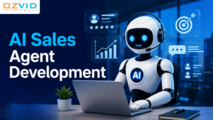
An AI agent is an intelligent software system designed to perceive information, reason through tasks, make decisions, and execute actions with limited human intervention. Unlike conventional automation, an AI agent can adapt to changing situations and work across connected business systems.
From answering customer queries and qualifying leads to managing internal requests, analyzing information, generating reports, and coordinating workflows, AI agents can become intelligent digital workers for businesses. They help organizations move beyond simple task automation toward more adaptive and scalable operations. For companies looking to improve productivity while maintaining better control over costs and resources, investing in AI agent development can create a strong foundation for smarter business automation.
AI is no longer limited to experimentation or innovation teams. According to McKinsey’s AI survey, 88% of respondents said their organizations regularly use AI in at least one business function, while 62% reported that their organizations were at least experimenting with AI agents. These figures show that businesses are increasingly moving toward intelligent technologies.
However, adopting an AI tool is not the same as transforming a business process. AI agents provide an opportunity to connect intelligence with action by allowing systems to reason through tasks and execute workflows. For businesses, the opportunity is therefore not simply to “use AI,” but to identify where intelligent agents can create measurable operational value.
Top Signs Your Business Needs an AI Agent
Businesses often adopt AI when repetitive work starts consuming valuable employee time, customer expectations increase, or existing automation becomes difficult to manage. Recognizing these signs early can help organizations identify processes where an AI agent can deliver meaningful improvements in efficiency, responsiveness, and scalability.
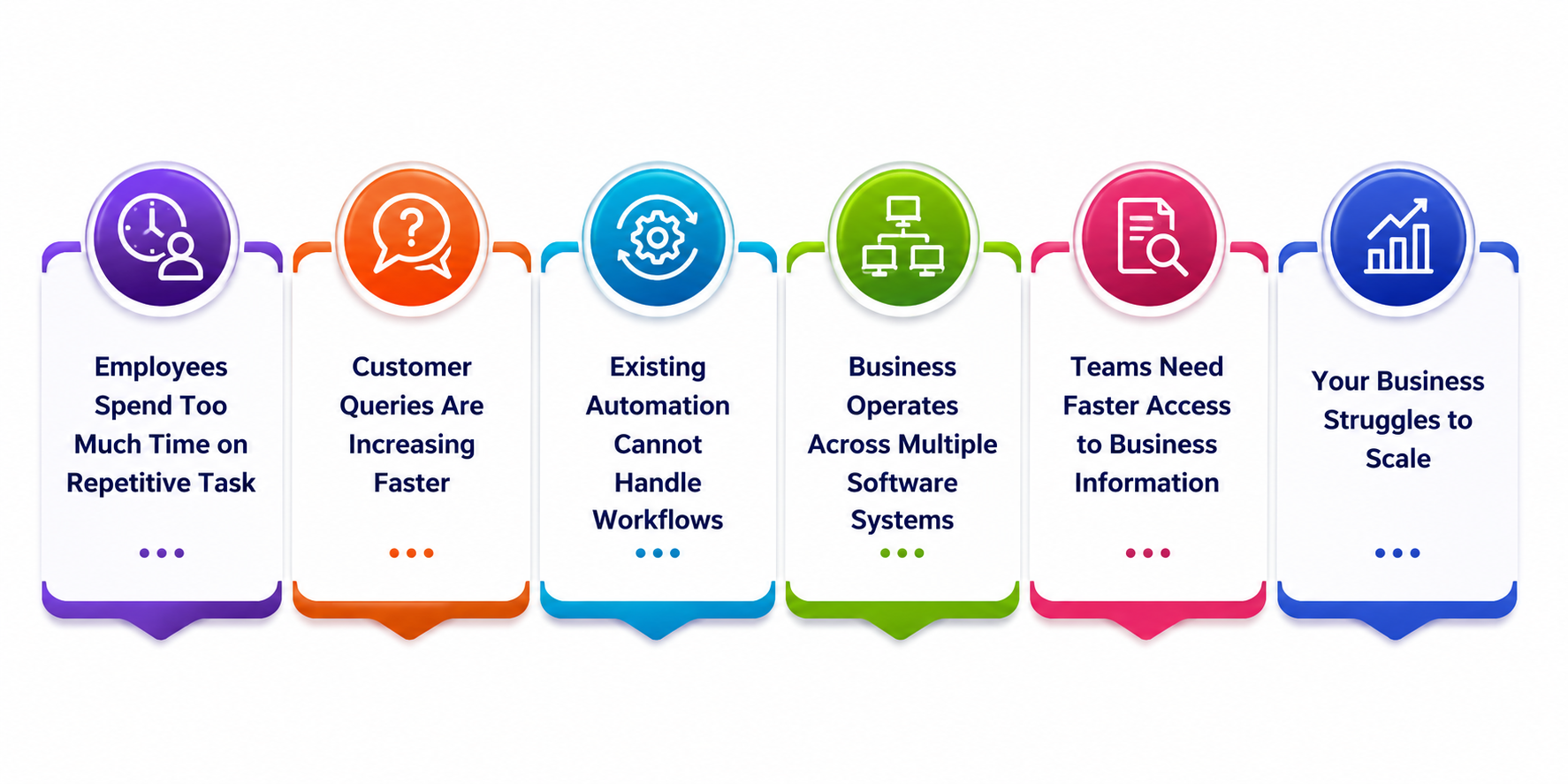
1. Employees Spend Too Much Time on Repetitive Tasks
When employees repeatedly answer similar questions, update records, prepare routine reports, transfer information, or follow predictable workflows, valuable working hours are being consumed by low-value activities. An AI agent can handle many repetitive processes while employees focus on activities requiring judgment, creativity, and business expertise.
- Reduce repetitive administrative work.
- Automate routine information processing.
- Free employees for strategic responsibilities.
- Improve overall workforce productivity.
2. Customer Queries Are Increasing Faster
Growing customer demand is positive, but support teams can quickly become overloaded when every inquiry requires manual attention. AI agents in businesses can understand customer questions, retrieve relevant information, provide appropriate responses, and escalate complex cases to human representatives when necessary.
- Provide faster customer responses.
- Support customers beyond standard working hours.
- Reduce pressure on support teams.
- Create more consistent customer interactions.
3. Existing Automation Cannot Handle Workflows
Rule-based automation works well when processes follow fixed conditions. However, business situations are not always predictable. If your workflows require interpretation, contextual decisions, information gathering, or multiple actions across systems, an AI agent can provide a more flexible approach.
- Handle multi-step workflows.
- Interpret unstructured business information.
- Adapt to changing circumstances.
- Coordinate actions across connected applications.
4. Business Operates Across Multiple Software Systems
Employees may spend significant time moving between CRM platforms, help desks, ERP systems, email, communication tools, databases, and other applications. AI agents can work as an intelligent layer between systems, helping coordinate information and actions across the technology ecosystem.
- Connect business applications.
- Reduce manual data movement.
- Improve workflow continuity.
- Minimize repetitive system switching.
5. Teams Need Faster Access to Business Information
Business decisions often depend on information spread across multiple databases, documents, reports, and applications. Searching for the right information manually can slow down employees. AI agents can retrieve relevant information, summarize findings, and help teams access useful insights more quickly.
- Accelerate information discovery.
- Summarize large volumes of data.
- Support faster decision-making.
- Improve employee access to knowledge.
6. Your Business Struggles to Scale
When business growth directly increases operational workload, companies may need additional employees simply to manage repetitive activities. AI agents can help organizations handle higher transaction volumes and customer interactions without requiring every increase in demand to be matched by proportional manual effort.
- Support business growth.
- Handle higher workflow volumes.
- Improve operational scalability.
- Optimize resource utilization.
Transform Business Operations with the Key Benefits of AI Agents
AI agents can create value across multiple departments by combining intelligent decision-making with workflow execution. Instead of simply generating information, they can help businesses act on that information. This makes agentic AI particularly useful for organizations seeking greater productivity, operational agility, improved customer experiences, and scalable automation.
1. Higher Operational Efficiency
AI agents can automate repetitive and time-consuming processes, allowing employees to spend more time on higher-value responsibilities. They can process requests, organize information, initiate workflows, and perform routine actions according to business rules and available context.
2. Faster Decision Support
AI agents can gather information from connected systems, analyze relevant data, summarize findings, and present useful insights. This can help managers and employees make informed decisions faster without spending excessive time manually collecting information from different sources.
3. Improved Customer Experience
Customers increasingly expect fast, relevant, and convenient interactions. AI agents can provide immediate assistance, personalize responses using available customer information, and route complex issues to appropriate employees. This creates a smoother experience while reducing pressure on customer service teams.
4. Reduced Operational Costs
Automating repetitive work can reduce the amount of manual effort required for routine business processes. Rather than replacing employees, organizations can use AI agents to augment their teams and help existing resources handle larger workloads more efficiently.
5. 24/7 Business Support
Unlike human teams that work within defined schedules, AI agents can remain available continuously. This can be particularly useful for customer support, internal knowledge assistance, lead qualification, monitoring, and other workflows where timely responses can influence business outcomes.
6. Better Employee Productivity
Employees often lose productivity when they repeatedly perform administrative activities or search for information. AI agents can become digital assistants that help employees complete routine tasks, retrieve knowledge, prepare information, and initiate processes more efficiently.
7. Greater Scalability
As organizations grow, manual workflows can become increasingly difficult to manage. AI agents can help businesses scale repetitive processes across larger volumes of transactions, requests, and interactions while maintaining consistent workflows and service standards.
8. More Consistent Business Processes
Human teams can naturally handle tasks differently, especially when processes involve multiple departments. AI agents can follow predefined policies, access approved information, and execute standardized workflows, helping businesses create greater consistency across routine operations.
Build a Smarter Agentic AI Strategy with These Investment Considerations
Investing in agentic AI should not begin with selecting a technology and searching for a use case afterward. Businesses should first identify measurable problems, evaluate their data and systems, and determine where autonomous or semi-autonomous workflows can create genuine value. A structured strategy helps reduce risks and improve long-term returns.
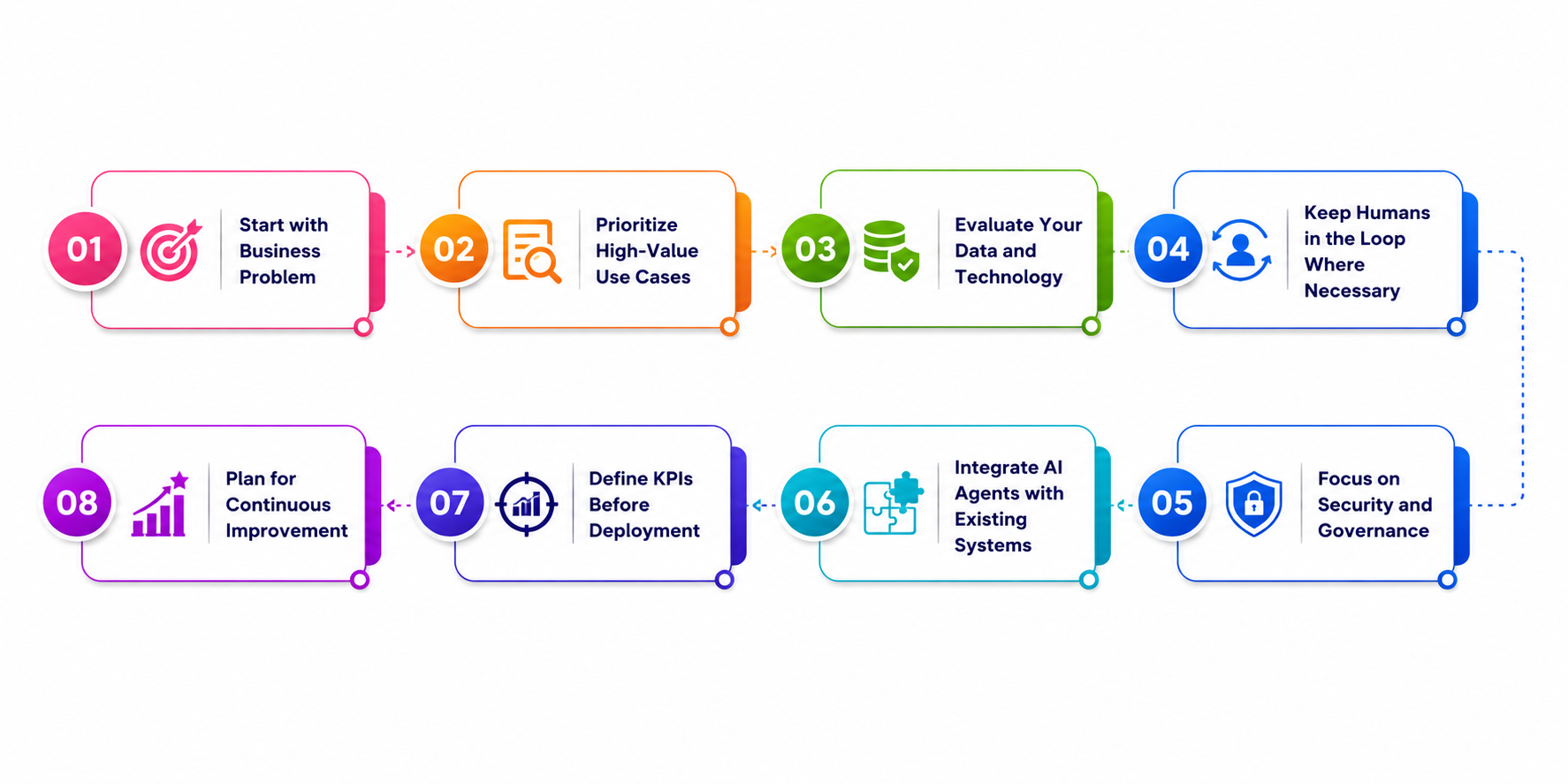
1. Start with Business Problem
The strongest AI agent initiatives solve specific business problems rather than adopting AI simply because it is trending. Identify processes involving high volumes, repetitive work, delays, customer friction, or unnecessary manual intervention before deciding what type of agent to build.
2. Prioritize High-Value Use Cases
Not every workflow requires an AI agent. Begin with use cases where automation can produce measurable improvements in productivity, response times, operating costs, customer satisfaction, or employee efficiency. Starting with focused applications can also make implementation and performance measurement easier.
3. Evaluate Your Data and Technology
AI agents depend on reliable information and access to relevant business systems. Before implementation, evaluate data quality, system architecture, APIs, permissions, databases, documentation, and integration requirements. Strong technical foundations help agents operate more reliably and reduce unnecessary implementation challenges.
4. Keep Humans in the Loop Where Necessary
AI agents should not automatically receive unrestricted authority over every business process. Organizations should determine which actions can be automated and which require employee review. Human oversight is especially important for sensitive, high-impact, or complex business decisions.
5. Focus on Security and Governance
AI agents may interact with business data, customer information, internal systems, and operational workflows. Security should therefore be incorporated from the beginning through access controls, authentication, monitoring, data protection, permissions, auditability, and appropriate governance policies.
6. Integrate AI Agents with Existing Systems
An isolated AI agent may provide limited value if it cannot interact with the systems employees already use. Integrating agents with CRM, ERP, help desk, communication, analytics, databases, and other relevant platforms can enable end-to-end workflow automation.
7. Define KPIs Before Deployment
Businesses need measurable indicators to determine whether an AI agent is delivering value. Establish KPIs such as response time, resolution rate, processing time, employee productivity, automation rate, customer satisfaction, cost savings, and workflow completion before launching the solution.
8. Plan for Continuous Improvement
AI agent deployment is not a one-time project. Business requirements, customer expectations, data, systems, and workflows continuously change. Organizations should monitor performance, evaluate outcomes, update knowledge, refine workflows, and improve integrations to keep agents aligned with business objectives.
Conclusion
AI agents represent the next step in business automation by combining artificial intelligence, reasoning, contextual understanding, and workflow execution. Businesses can work with an AI Agent development company to build intelligent solutions that go beyond basic rule-based automation, creating smarter processes capable of handling increasingly complex operational requirements.
From customer support and sales to HR, finance, IT, and operations, AI agents can reduce repetitive work, improve response times, support employees, and help businesses scale more efficiently. However, successful implementation depends on selecting the right use cases, preparing reliable data, integrating existing systems, establishing security controls, and maintaining appropriate human oversight.
At OZVID Technologies, we help businesses explore and implement intelligent technology solutions designed around their specific operational requirements. Our AI development approach focuses on building practical, scalable, and business-oriented solutions that connect AI capabilities with real-world workflows.
Whether your goal is to automate customer interactions, streamline internal operations, improve productivity, or develop a sophisticated agentic AI platform, the right AI strategy can help turn automation into a long-term competitive advantage. Contact us today.
Frequently Asked Questions
1. What is an AI agent in business automation?
An AI agent is an intelligent software system that can understand information, reason through tasks, and execute actions across business workflows with limited human intervention.
- Automates multi-step processes.
- Understands contextual information.
- Connects with business systems.
- Supports employees and customers.
2. How can AI agents improve business productivity?
AI agents reduce repetitive manual work and help employees retrieve information, manage routine workflows, respond to requests, and complete operational tasks more efficiently.
- Reduce administrative workload.
- Accelerate routine processes.
- Improve employee efficiency.
- Support higher work volumes.
3. Which business departments can use AI agents?
AI agents can support departments such as customer service, sales, marketing, HR, finance, IT, operations, and management by automating relevant workflows and information-based activities.
- Customer support automation.
- Lead qualification.
- HR assistance.
- IT service management.
4. Are AI agents better than traditional automation?
AI agents can be more suitable for workflows requiring contextual understanding, flexible decision-making, and multiple steps, while traditional automation remains effective for predictable rule-based processes.
- Handle dynamic workflows.
- Interpret business context.
- Coordinate multiple actions.
- Complement existing automation.
5. How should a business start investing in agentic AI?
Businesses should begin by identifying high-value, repetitive workflows and evaluating data, integrations, security, KPIs, and human oversight requirements before selecting an AI agent solution.
- Define business objectives.
- Select suitable use cases.
- Assess technology readiness.
- Establish measurable KPIs.
6. How can businesses measure the success of an AI agent?
Success can be measured through operational and business KPIs such as processing time, automation rate, customer satisfaction, resolution rates, productivity improvements, cost efficiency, and workflow completion.
- Track automation rates.
- Measure response times.
- Monitor customer outcomes.
- Evaluate operational savings.