
As enterprises continue to embrace digital transformation, iOS applications have become an essential tool for improving operational efficiency, enhancing customer engagement, and streamlining business workflows. Apple's ecosystem is renowned for its security, reliability, premium user experience, and seamless integration across devices, making enterprise iOS app development a preferred choice for organizations worldwide.
From healthcare and finance to logistics, retail, manufacturing, and education, enterprises are investing in custom iOS applications to automate internal processes, enable remote workforces, manage real-time data, and deliver exceptional customer experiences. Unlike consumer applications, enterprise iOS apps are designed with scalability, security, compliance, and integration capabilities that support complex business operations.
However, enterprise app development requires careful planning, advanced architecture, robust security measures, third-party integrations, and continuous maintenance. Understanding the development process, essential features, business benefits, and overall development costs helps organizations make informed investment decisions.
Key Takeaways
- Enterprise iOS applications offer industry-leading security, making them ideal for businesses handling sensitive customer and organizational data.
- Custom enterprise apps streamline operations, improve employee productivity, and automate repetitive business processes.
- Apple's ecosystem provides exceptional performance, reliability, long-term support, and seamless integration across iPhones, iPads, Macs, and Apple Watch.
- Enterprise apps require advanced architecture, API integrations, compliance standards, and scalable infrastructure, increasing development complexity.
- The development process includes discovery, UI/UX design, development, testing, deployment, and continuous maintenance.
- Development costs vary based on features, integrations, security requirements, team size, and project complexity.
- Partnering with an experienced enterprise iOS development company ensures faster delivery, higher quality, and better long-term ROI.
Why Enterprise iOS App Development Requires a Higher Investment
Enterprise iOS app development involves far more than building a standard mobile application. These solutions are designed to support complex business operations, integrate with enterprise software, protect sensitive data, and scale as organizations grow. The additional planning, advanced technologies, and ongoing maintenance contribute to higher development costs while delivering long-term business value.
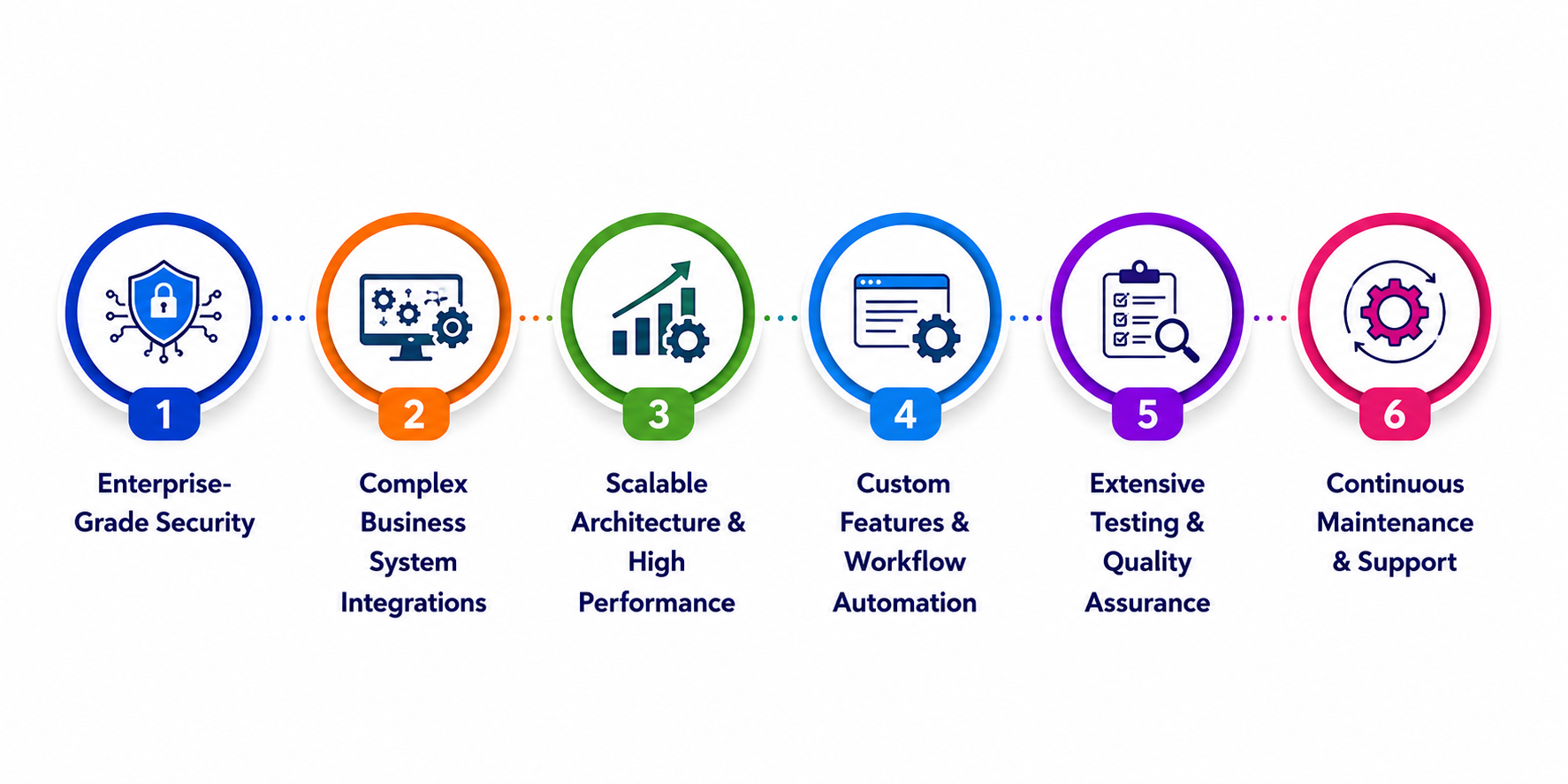
1. Enterprise-Grade Security
Enterprise applications manage sensitive business and customer information, requiring advanced security measures such as encryption, multi-factor authentication, secure APIs, and compliance with regulations like GDPR, HIPAA, or PCI DSS. Implementing these safeguards increases development time, testing efforts, and overall project costs.
2. Complex Business System Integrations
Enterprise apps must seamlessly integrate with existing systems such as ERP, accounting platforms, cloud services, and third-party APIs. Developing secure, reliable, and real-time integrations requires experienced developers, extensive testing, and customized solutions, adding to the overall investment.
3. Scalable Architecture & High Performance
Unlike consumer apps, enterprise applications must support thousands of users, growing datasets, and expanding business operations. Building scalable architecture, optimizing performance, and ensuring system reliability require advanced engineering practices, cloud infrastructure, and future-ready development strategies
4. Custom Features & Workflow Automation
Every enterprise has unique operational processes, approval workflows, reporting requirements, and automation needs. Developing highly customized features instead of using standard templates requires detailed business analysis, custom coding, and continuous refinement, increasing both development complexity and cost.
5. Extensive Testing & Quality Assurance
Enterprise iOS applications undergo rigorous testing to ensure security, performance, usability, compatibility, and reliability across multiple Apple devices. Comprehensive quality assurance, penetration testing, and performance optimization help deliver a stable application but require additional time and resources.
6. Continuous Maintenance
Enterprise applications require ongoing maintenance after deployment, including security updates, OS compatibility, feature enhancements, bug fixes, and performance improvements. Continuous monitoring and long-term technical support ensure the application remains secure, efficient, and aligned with evolving business requirements.
Essential Features That Power Successful Enterprise iOS Applications
Enterprise iOS applications are built to solve complex business challenges while ensuring security, scalability, and exceptional user experiences. The following features help organizations maximize productivity, improve collaboration, and maintain operational excellence across departments.
1. Enterprise-Grade Security
Enterprise applications handle confidential customer information, financial records, employee data, and business assets. Advanced security mechanisms ensure that data remains protected from cyber threats while maintaining compliance with industry regulations and internal governance policies.
2. Cloud Integration
Cloud connectivity enables employees to access business information anytime and from any location. Real-time synchronization keeps data updated across multiple devices, departments, and enterprise systems, improving collaboration and reducing manual data duplication.
3. Advanced Analytics
Modern enterprise apps collect valuable business data that helps organizations make informed decisions. Interactive dashboards, performance reports, and predictive analytics enable management teams to monitor KPIs and optimize operational performance.
4. Third-Party Enterprise Integrations
Enterprise applications rarely operate independently. Integration with ERP, CRM, HRMS, accounting software, payment gateways, and communication platforms creates a centralized ecosystem that improves workflow efficiency and data consistency.
5. Offline Functionality
Business operations often continue in environments with limited internet connectivity. Offline capabilities allow employees to access essential information, perform tasks, and automatically synchronize data once connectivity is restored.
6. Push Notifications
Timely notifications improve communication between employees, customers, and management teams. Instant alerts ensure users receive important updates, approvals, reminders, and business-critical information without delays.
7. Scalable Architecture
Enterprise applications must accommodate business growth without compromising performance. Scalable architecture supports increasing users, larger datasets, additional integrations, and future feature expansion while maintaining optimal speed and reliability.
Business Benefits of Investing in Enterprise iOS Applications
Enterprise iOS applications are more than just business tools, they are strategic assets that help organizations improve efficiency, strengthen security, and accelerate digital transformation. By leveraging Apple's secure ecosystem and advanced technologies, businesses can automate operations, improve employee collaboration, enhance customer engagement, and make smarter decisions using real-time data.
1. Improved Operational Efficiency
Enterprise iOS applications automate repetitive business processes, eliminate manual paperwork, and streamline workflows across multiple departments. Employees can complete tasks faster using mobile devices, while managers gain better visibility into daily operations through centralized dashboards. Automation minimizes human errors, reduces administrative overhead, and enables businesses to focus on innovation and strategic growth instead of routine operational activities.
2. Enhanced Data Security
Security is one of the biggest reasons enterprises choose the iOS platform. Apple's robust security framework, combined with enterprise-grade encryption, biometric authentication, secure APIs, and role-based access controls, protects sensitive organizational data from cyber threats. These applications also support compliance with industry regulations, ensuring businesses maintain customer trust while minimizing security risks and data breaches.
3. Better Employee Productivity
Enterprise iOS applications empower employees by providing secure access to business systems anytime and anywhere. Whether working remotely, traveling, or operating in the field, employees can collaborate with teams, update records, manage projects, and access important information directly from their iPhones or iPads. This flexibility improves productivity, decision-making, and overall workforce efficiency.
4. Superior Customer Experience
Modern customers expect fast, personalized, and seamless digital experiences. Enterprise iOS applications enable businesses to deliver responsive customer service, personalized recommendations, real-time support, and intuitive mobile interactions. Enhanced customer engagement not only improves satisfaction but also increases loyalty, strengthens brand reputation, and creates long-term business relationships.
5. Data-Driven Business Decisions
Enterprise iOS applications collect and analyze valuable business data in real time, enabling organizations to make informed decisions based on accurate insights rather than assumptions. Interactive dashboards, performance reports, predictive analytics, and KPI tracking help business leaders identify trends, monitor operations, forecast future opportunities, and optimize organizational performance with greater confidence.
6. Increased Business Scalability
As organizations expand, their technology must evolve alongside growing operational demands. Enterprise iOS applications are built with scalable architectures that support increasing users, additional business locations, new service offerings, and evolving customer expectations. This flexibility allows businesses to introduce new features and integrate emerging technologies without rebuilding the entire application.
7. Higher Return on Investment
Although enterprise iOS app development requires a significant upfront investment, the long-term financial benefits far outweigh the initial costs. Increased operational efficiency, reduced manual labor, improved customer retention, streamlined business processes, and enhanced employee productivity contribute to lower operating expenses and higher profitability. Over time, businesses achieve stronger returns through improved performance, scalability, and sustained competitive advantage.
Enterprise iOS App Development Process: From Strategy to Deployment
Building a successful enterprise iOS application requires a structured development approach that aligns technology with business objectives. Every stage ensures the final product is secure, scalable, user-friendly, and capable of supporting evolving enterprise requirements.
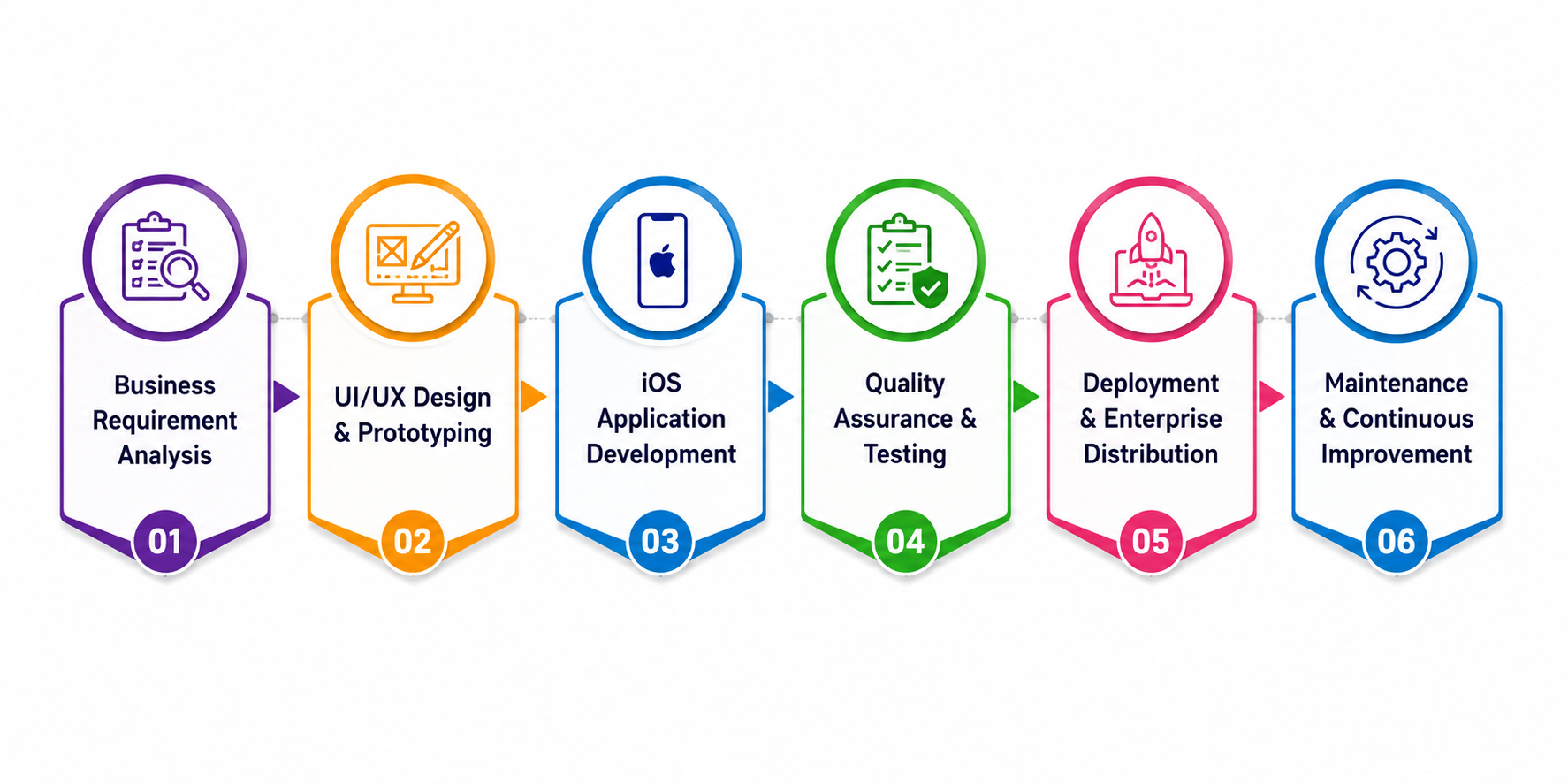
1. Business Requirement Analysis
The development journey begins with understanding business goals, operational challenges, target users, compliance requirements, and technical expectations to create a comprehensive project roadmap.
- Requirement gathering
- Business analysis
- Technical planning
- Project roadmap
2. UI/UX Design & Prototyping
Design teams create intuitive interfaces, wireframes, and interactive prototypes that ensure exceptional user experiences while maintaining consistency with Apple's Human Interface Guidelines.
- Wireframing
- Interactive prototypes
- User testing
- UI optimization
3. iOS Application Development
Developers build scalable applications using Swift, modern frameworks, secure APIs, cloud integrations, and enterprise architecture while ensuring optimal performance.
- Swift development
- API integration
- Secure coding
- Modular architecture
4. Quality Assurance & Testing
Comprehensive testing verifies functionality, security, performance, compatibility, and usability across multiple Apple devices before deployment.
- Functional testing
- Security testing
- Performance optimization
- Bug fixing
5. Deployment & Enterprise Distribution
After successful testing, the application is deployed through the Apple App Store or enterprise distribution channels depending on organizational requirements.
- App deployment
- Store submission
- Enterprise distribution
- Release management
6. Maintenance & Continuous Improvement
Regular updates, security patches, feature enhancements, and performance monitoring ensure the application remains competitive and aligned with evolving business needs.
- Performance monitoring
- Feature updates
- Security improvements
- Technical support
Enterprise iOS App Development Cost
Enterprise iOS app development costs depend on application complexity, security requirements, integrations, design customization, AI capabilities, cloud infrastructure, testing, and ongoing maintenance. Organizations should consider development as a long-term investment that delivers improved efficiency, enhanced security, and greater operational scalability.
Development Stage | Estimated Cost (USD) |
Business Analysis & Planning | $3,000 – $8,000 |
UI/UX Design | $5,000 – $15,000 |
Basic Enterprise App | $20,000 – $40,000 |
Medium Complexity App | $40,000 – $80,000 |
Advanced Enterprise App | $80,000 – $180,000+ |
API & Third-Party Integrations | $5,000 – $25,000 |
AI & Machine Learning Features | $10,000 – $50,000 |
Security & Compliance Implementation | $8,000 – $30,000 |
Testing & Quality Assurance | $5,000 – $20,000 |
Annual Maintenance | 15–20% of Development Cost |
Conclusion
Enterprise iOS applications have become a strategic investment for businesses seeking to improve productivity, strengthen security, streamline operations, and deliver exceptional digital experiences. With Apple's secure ecosystem, powerful development frameworks, and premium user experience, enterprise iOS solutions enable organizations to remain competitive in an increasingly digital marketplace.
At OZVID Technologies, we specialize in building scalable, secure, and high-performance enterprise iOS applications tailored to your unique business objectives. From strategy and UI/UX design to development, deployment, and ongoing support, our experienced iOS developers deliver custom solutions that drive innovation, operational efficiency, and long-term business growth. Whether you're modernizing internal workflows or launching a customer-facing enterprise platform, OZVID Technologies is your trusted technology partner. Contact us.
Frequently Asked Questions
1. Why should enterprises invest in custom iOS app development instead of off-the-shelf software?
Custom iOS applications are designed specifically for your business processes, enabling seamless integration with existing systems, stronger security, better scalability, and features tailored to your operational needs, resulting in higher productivity and long-term ROI.
2. Which industries benefit the most from enterprise iOS applications?
Industries such as healthcare, finance, retail, logistics, manufacturing, education, insurance, real estate, and hospitality benefit significantly from enterprise iOS apps by improving workflow automation, customer engagement, operational efficiency, and data management.
3. How long does it take to develop an enterprise iOS application?
Development timelines vary based on complexity. A basic enterprise app may take 3–5 months, while feature-rich enterprise solutions with integrations, AI capabilities, and advanced security can require 6–12 months or longer.
4. What factors influence the cost of enterprise iOS app development?
Key cost factors include app complexity, UI/UX design, third-party integrations, backend infrastructure, cloud services, security and compliance requirements, AI features, testing, deployment, and ongoing maintenance.
5. Can enterprise iOS applications integrate with existing business systems?
Yes. Enterprise iOS apps can integrate with ERP, CRM, HRMS, accounting software, payment gateways, cloud platforms, IoT devices, and other business tools through secure APIs to create a unified and efficient business ecosystem.
6. Why should businesses choose OZVID Technologies for enterprise iOS app development?
OZVID Technologies provides end-to-end enterprise iOS app development services, including business consulting, UI/UX design, secure app development, system integrations, testing, deployment, and long-term maintenance, helping businesses build scalable and future-ready digital solutions.