Key Takeaways
- An MVP (Minimum Viable Product) helps businesses validate ideas with minimum investment and faster market entry.
- MVP development services reduce development risks by testing product-market fit before full-scale development.
- Startups and enterprises can use MVPs to gather user feedback, attract investors, and optimize product features.
- The cost of MVP development depends on complexity, technology stack, development team, and integrations.
- Choosing the right MVP development company ensures scalable architecture, faster delivery, and future-ready solutions.
- A well-planned MVP lays the foundation for successful digital products with continuous improvements based on real customer insights.
Launching a successful digital product is no longer about building every possible feature before entering the market. Today's competitive business environment demands speed, innovation, and customer validation. Whether you're a startup with a groundbreaking idea or an enterprise looking to launch a new digital solution, investing heavily without validating market demand can result in wasted resources and missed opportunities.
This is where MVP (Minimum Viable Product) Development Services become invaluable. An MVP allows businesses to create a functional version of their product with only the essential features needed to solve a core customer problem. Instead of spending months or years developing a complete solution, organizations can release an MVP quickly, collect real-world user feedback, validate assumptions, and continuously improve the product.
An MVP is much more than a simplified application. It is a strategic product development approach that minimizes business risks while maximizing learning opportunities. Successful companies including Airbnb, Dropbox, Uber, Spotify, and Instagram all started with MVPs before evolving into globally recognized platforms.
For startups, MVP development helps secure investor confidence by proving market demand with actual users. For enterprises, MVPs reduce innovation risks, accelerate digital transformation initiatives, and enable organizations to test new business models before committing significant budgets.
In this comprehensive guide, we'll explore MVP development services, their benefits, development process, estimated costs, different MVP types, and how businesses can successfully launch scalable products.

The Growing Demand for MVP Development
The growing startup ecosystem and increasing enterprise digital transformation initiatives continue to fuel demand for MVP development worldwide.
According to Grand View Research, the global application development software market is projected to continue expanding significantly through 2030, driven by increasing investments in digital transformation, cloud technologies, and enterprise software modernization. Additionally, Fortune Business Insights projects the global software development market to experience strong growth throughout the forecast period as organizations increasingly adopt agile development methodologies and cloud-native applications. These trends clearly demonstrate why businesses are prioritizing rapid product validation before investing in large-scale software development.
Why MVP Development Services Are the Smartest Investment for Modern Businesses
MVP development services enable businesses to validate product ideas quickly while minimizing financial risks. Instead of investing in complete software development, organizations build essential features, gather user feedback, and continuously improve their products. This approach reduces uncertainty, accelerates innovation, improves customer satisfaction, and increases the chances of long-term business success.
Why MVP Development Services Are the Smartest Investment for Modern Businesses
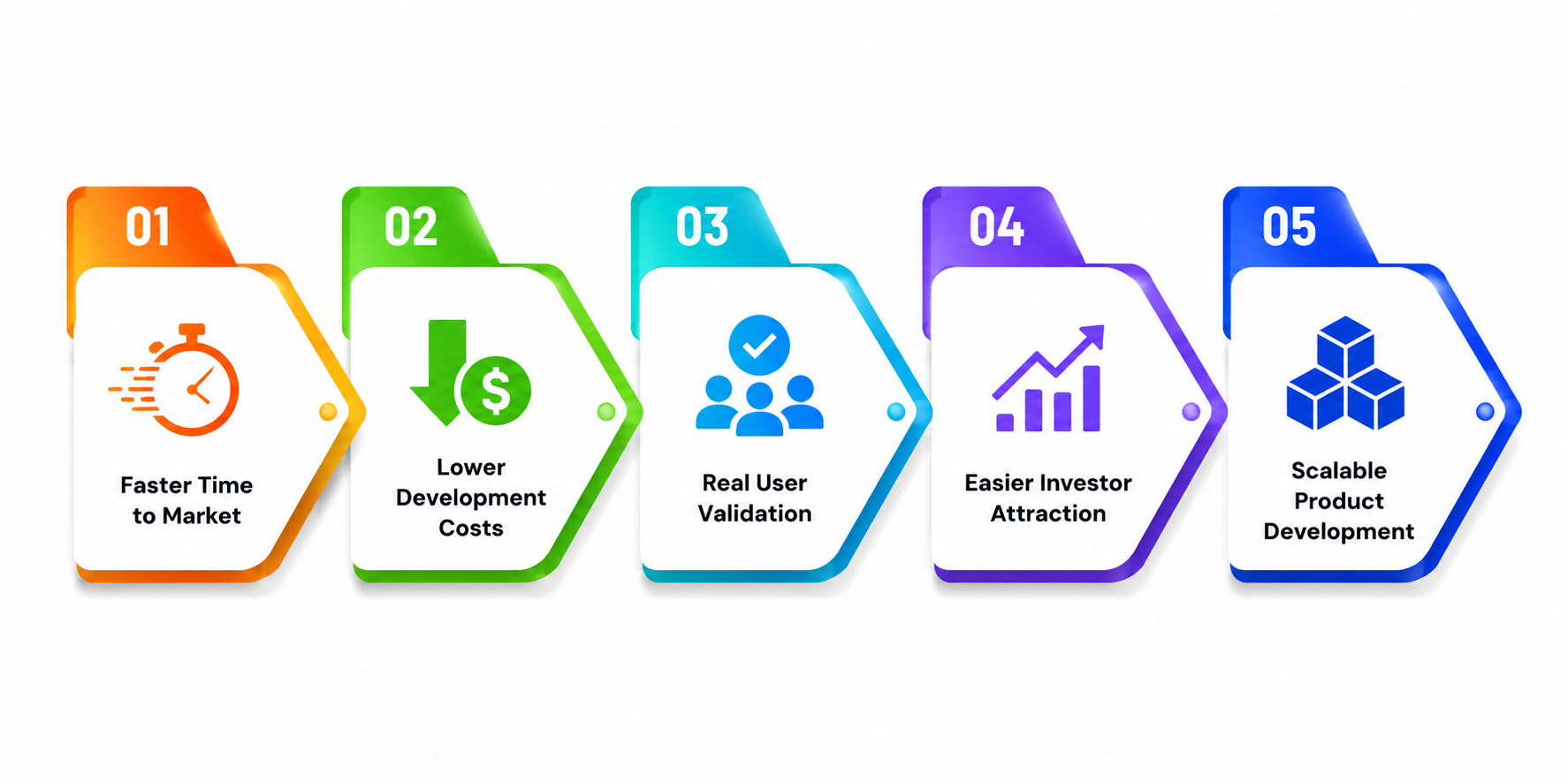
1. Faster Time to Market
Launching quickly allows businesses to validate ideas before competitors. MVP development focuses only on the most valuable features, significantly reducing development time. Businesses receive early customer feedback, identify improvement areas, and start generating market traction much earlier than traditional software development approaches.
- Launch products in weeks instead of months
- Gain competitive advantage
- Receive customer feedback early
- Begin revenue generation sooner
2. Lower Development Costs
Building only essential features significantly reduces the initial investment required. Instead of allocating large budgets toward uncertain ideas, companies invest strategically. MVP development enables organizations to validate concepts before expanding functionality, preventing unnecessary spending on features users may never utilize.
- Lower initial investment
- Better budget allocation
- Reduced financial risks
- Higher return on investment
3. Real User Validation
Rather than relying on assumptions, businesses receive direct customer feedback from real users. This data helps prioritize future features, improve usability, and understand customer behavior, resulting in products that better align with market expectations and customer requirements.
- Validate product-market fit
- Understand customer behavior
- Improve customer satisfaction
- Prioritize valuable features
4. Easier Investor Attraction
Investors prefer startups that demonstrate traction instead of just presenting ideas. An MVP showcases market validation, user engagement, customer feedback, and growth potential, making fundraising significantly easier while improving investor confidence in the business model.
- Demonstrates business potential
- Builds investor confidence
- Shows market demand
- Supports funding opportunities
5. Scalable Product Development
An MVP establishes a strong technical foundation for future growth. Once market validation is complete, businesses can gradually add advanced features without rebuilding the entire system, ensuring scalability, flexibility, and long-term product sustainability.
- Future-ready architecture
- Easy feature expansion
- Improved scalability
- Long-term product flexibility
Understanding MVP Development Costs: What Businesses Should Expect
The cost of MVP development varies depending on product complexity, required features, design quality, development platform, integrations, security requirements, and the expertise of the development team. Understanding these cost factors helps businesses plan realistic budgets while maximizing value and reducing unnecessary development expenses.
MVP Complexity | Estimated Cost |
|---|---|
Basic MVP | $15,000 – $30,000 |
Standard MVP | $30,000 – $60,000 |
Advanced MVP | $60,000 – $120,000+ |
Factors Affecting MVP Cost
The cost of developing a Minimum Viable Product (MVP) varies depending on several technical and business factors. Here are a few factors associated with the cost:
1. Features & Functionalities
The number and complexity of features included in your MVP have the greatest impact on development costs. While an MVP focuses on delivering only the essential functionality, some products require advanced capabilities such as user authentication, payment processing, real-time messaging, AI-powered recommendations, analytics dashboards, or geolocation services.
2. Platform Selection
The platform you choose for your MVP significantly influences both development timelines and overall costs. A web application generally requires less investment than building separate native applications for Android and iOS.
3. UI/UX Design
An intuitive and user-friendly interface plays a crucial role in the success of an MVP. Although the goal is to minimize unnecessary design efforts, investing in high-quality UI/UX ensures users can easily navigate the product and accomplish their goals.
4. Third-Party Integrations
Most MVPs rely on third-party services to extend functionality without building everything from scratch. Integrations such as payment gateways, cloud storage, customer relationship management (CRM) systems, social media logins, maps, AI services, communication APIs, and analytics platforms can accelerate development but also increase implementation complexity.
5. Development Team
The expertise and location of your development team directly affect the quality, speed, and cost of MVP development. Hiring an experienced MVP development company provides access to skilled project managers, business analysts, UI/UX designers, developers, QA engineers, and DevOps specialists.
MVP Development Process: From Idea Validation to Product Launch
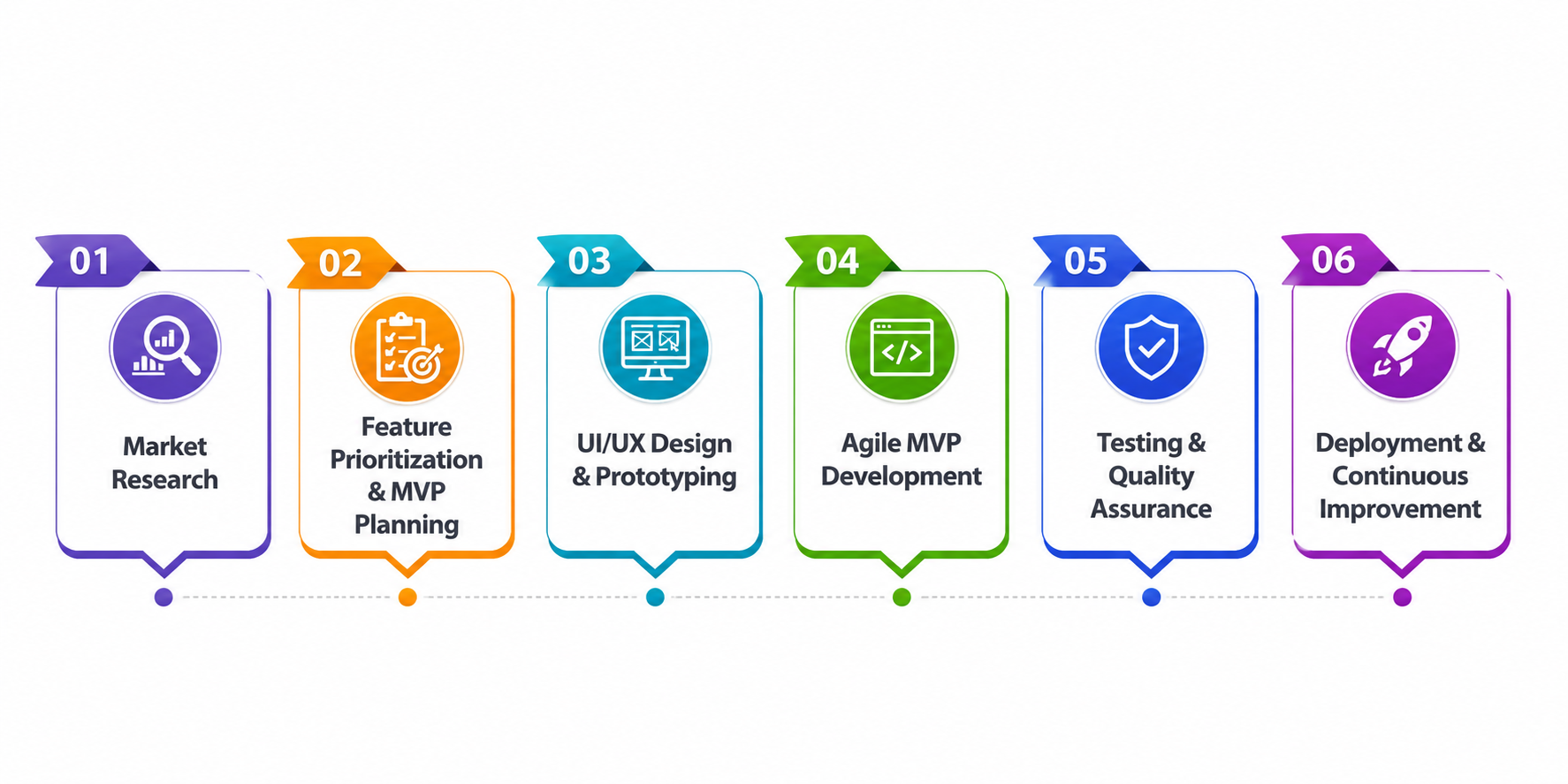
A structured MVP development process transforms business ideas into market-ready digital products through research, planning, agile development, testing, deployment, and continuous improvements. Following a proven process ensures faster delivery, reduced risks, better product quality, and successful validation using real customer feedback.
1. Market Research
Every successful MVP begins with thorough market research and product discovery. Before writing a single line of code, businesses need to understand their target audience, competitors, market trends, and customer pain points. This stage focuses on validating the business idea, identifying opportunities, and ensuring there is genuine demand for the proposed solution.
Key Activities:
- Competitor analysis
- Target audience research
- Customer pain point identification
- Business goal definition
2. Feature Prioritization & MVP Planning
Once the product idea has been validated, the next step is determining which features should be included in the MVP. Instead of developing every planned functionality, businesses focus only on the core features that solve the primary customer problem. Product managers use prioritization frameworks, customer feedback, and business objectives to create a feature roadmap that balances user value with development efficiency.
Key Activities:
- User story creation
- Feature prioritization
- MVP scope definition
- Product roadmap planning
3. UI/UX Design & Prototyping
An MVP should not only function effectively but also provide a seamless user experience. During the UI/UX design phase, designers create intuitive interfaces that make the product easy to understand and use. Wireframes, mockups, and interactive prototypes allow stakeholders and potential users to visualize the product before development begins.
Key Activities:
- Wireframe creation
- Interactive prototypes
- User journey mapping
- Responsive interface design
4. Agile MVP Development
With the design finalized, developers begin building the MVP using agile development methodologies. The project is divided into short development cycles, known as sprints, allowing teams to deliver functional features incrementally. Agile development encourages continuous collaboration between developers, designers, product managers, and stakeholders, ensuring the product evolves according to business goals and customer feedback.
Key Activities:
- Sprint planning
- Iterative development
- Scalable architecture implementation
- Continuous integration and deployment
5. Testing & Quality Assurance
Before launching the MVP, comprehensive testing is essential to ensure reliability, performance, and security. Quality assurance engineers evaluate every aspect of the application, including functionality, usability, compatibility, performance, and data protection. Identifying and resolving issues during this stage minimizes the risk of negative user experiences after launch.
Key Activities:
- Functional testing
- Performance and load testing
- Security and vulnerability testing
- Cross-platform and compatibility testing
6. Deployment & Continuous Improvement
Launching the MVP is not the end of the mobile app development journey, it marks the beginning of continuous product evolution. Once the MVP is deployed, businesses monitor user behavior, collect customer feedback, and analyze performance metrics to understand how the product is being used. These insights help identify opportunities for improvement, prioritize new features, and optimize the user experience.
Key Activities:
- Product deployment
- User analytics monitoring
- Customer feedback collection
- Feature enhancements and product scaling
Types of MVPs
Different MVP approaches help businesses validate ideas based on their product goals, target audience, and available resources.
MVP Type | Description | Best For |
Single Feature MVP | Focuses on one core functionality that solves the primary customer problem. | Startups |
Landing Page MVP | Validates customer interest through marketing pages before development. | Market validation |
Concierge MVP | Services are manually delivered before automation begins. | Service businesses |
Wizard of Oz MVP | Appears fully automated while processes run manually behind the scenes. | Product testing |
Prototype MVP | Demonstrates workflows and product concepts without complete functionality. | Investor presentations |
Piecemeal MVP | Combines existing software tools to validate business ideas with minimal development. | Budget-conscious startups |
Mobile App MVP | Launches essential mobile application features for early users. | Mobile startups |
SaaS MVP | Develops cloud-based software with core functionalities for subscription businesses. | SaaS companies |
Web MVP | Builds browser-based applications for quick deployment and user validation. | Enterprises & startups |
Conclusion
Building a successful digital product begins with validating the right idea—not building every possible feature from day one. MVP development services enable startups and enterprises to reduce risks, launch faster, gather real customer insights, and make data-driven decisions before investing in full-scale development.
Whether you are creating a SaaS platform, mobile application, enterprise solution, AI-powered product, or marketplace, a strategically planned MVP provides the foundation for long-term growth and sustainable success.
At OZVID Technologies, we specialize in delivering scalable MVP development services tailored to your business goals. Our experienced product consultants, UI/UX designers, developers, and QA engineers help businesses transform innovative ideas into market-ready products using agile methodologies, modern technologies, and customer-focused strategies. From product discovery to deployment and continuous enhancement, we partner with you throughout your product journey to ensure faster market entry and long-term business success. Contact us today.
Frequently Asked Questions
1. Why should startups invest in MVP development services?
MVP development helps startups validate business ideas, reduce investment risks, attract investors, gather customer feedback, and achieve faster market entry while minimizing unnecessary development expenses.
2. How long does it take to develop an MVP?
Most MVPs can be developed within 8 to 16 weeks, depending on feature complexity, technology stack, third-party integrations, and project scope.
3. Can enterprises benefit from MVP development?
Yes. Enterprises use MVPs to validate new digital products, test innovative business models, evaluate customer demand, and reduce the risks associated with large-scale software investments.
4. What industries benefit most from MVP development?
Healthcare, FinTech, eCommerce, Logistics, Education, Real Estate, Manufacturing, Travel, Food Delivery, AI, SaaS, and Enterprise Software companies commonly leverage MVP development services.
5. Why choose OZVID Technologies for MVP development?
OZVID Technologies offers end-to-end MVP development services, including product discovery, UI/UX design, agile development, quality assurance, cloud deployment, and continuous product enhancement. Our experienced team helps startups and enterprises build scalable, secure, and market-ready MVPs that accelerate business growth.