- Aug 06, 2026
Share this post on:
Key Takeaways
- The cost to develop an app like Swiggy typically ranges from $20,000 to $150,000+, depending on features, platform, UI/UX, and development complexity.
- A food delivery platform requires multiple applications, including customer, restaurant, delivery partner, and admin panels.
- AI-powered recommendations, real-time order tracking, and smart route optimization significantly improve customer satisfaction and operational efficiency.
- Choosing scalable technologies and cloud infrastructure ensures your application can handle increasing users and orders.
- Integrating secure payment gateways, GPS tracking, and push notifications is essential for delivering a seamless user experience.
- Regular maintenance, feature enhancements, and security updates should be included in your long-term budget.
- Partnering with an experienced app development company helps reduce development risks while accelerating time-to-market.
The online food delivery industry has transformed the way customers discover, order, and enjoy meals. Instead of calling restaurants or waiting in long queues, users now expect instant access to thousands of restaurants, real-time delivery tracking, multiple payment options, personalized recommendations, and seamless ordering, all from a single mobile application.
Among the leading players in this industry, Swiggy has established itself as one of the most successful food delivery platforms by combining convenience, technology, and customer-centric services. Its business model connects customers, restaurants, and delivery partners through a single digital ecosystem, making food ordering faster and more efficient than ever before. As consumer demand for online food delivery continues to rise globally, startups, restaurant chains, cloud kitchens, and entrepreneurs are increasingly looking to build app like Swiggy.
The online food delivery market continues to expand as consumers increasingly prefer the convenience of ordering meals through mobile applications. Businesses investing in food delivery platforms can benefit from strong market growth and evolving digital consumer behavior.
The global online food delivery market is projected to grow to USD 357.3 billion by 2034, exhibiting a compound annual growth rate (CAGR) of 8.93% during the forecast period (2026–2034). The market's growth is fueled by increasing smartphone adoption, changing consumer lifestyles, rising demand for convenience, and the rapid expansion of digital payment solutions and cloud kitchens.
Creating an App Like Swiggy: Business Benefits That Drive Long-Term Growth
A food delivery application is much more than an ordering platform. It serves as a complete digital marketplace that connects restaurants, customers, and delivery executives while automating operations, increasing customer engagement, and generating recurring revenue. Businesses that invest in a scalable platform can expand rapidly and create multiple revenue streams.
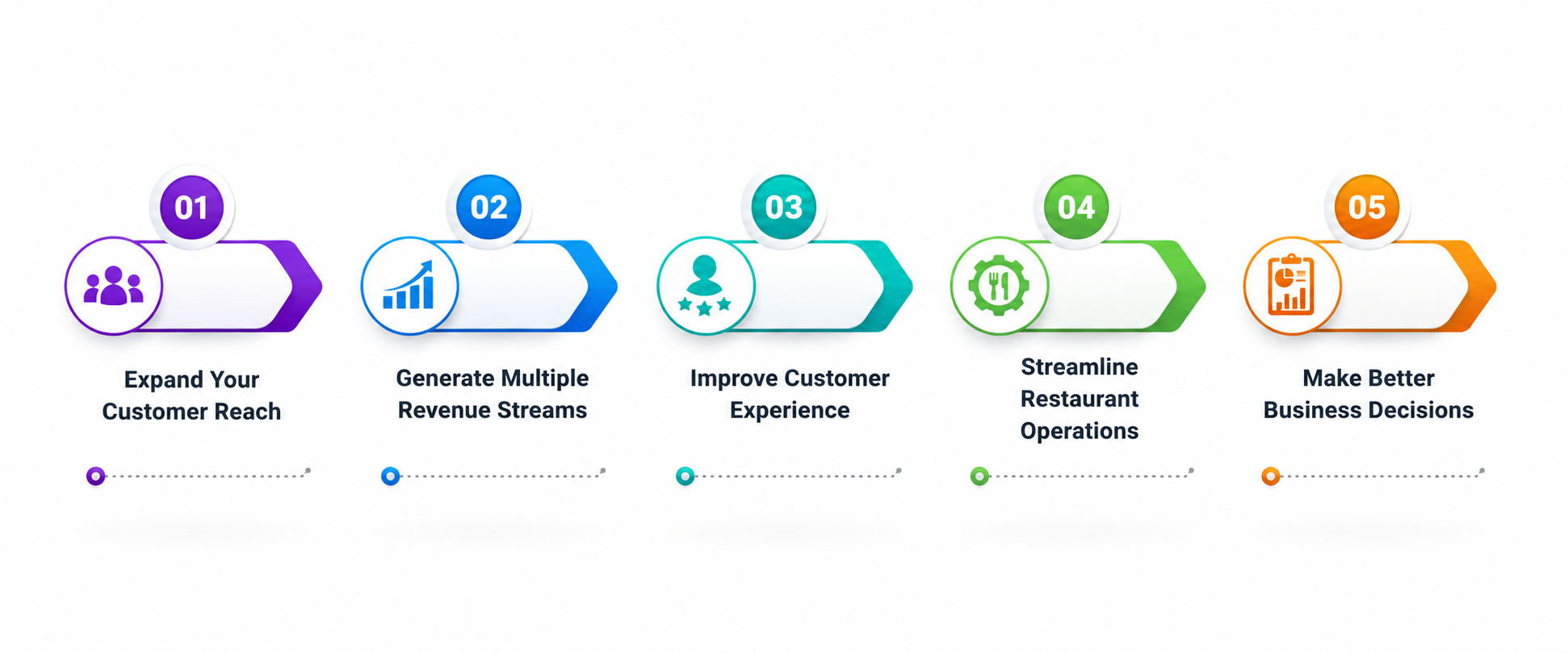
1. Expand Your Customer Reach
A food delivery application removes geographical limitations by allowing restaurants to serve customers across multiple locations. Instead of relying solely on walk-in traffic, businesses can reach thousands of users searching for meals online, increasing visibility, attracting new customers, and driving higher daily order volumes through a centralized digital platform.
- Increase online visibility across multiple cities
- Reach customers beyond restaurant locations
- Generate higher daily order volumes
- Build a stronger digital presence
2. Generate Multiple Revenue Streams
An application similar to Swiggy offers numerous monetization opportunities beyond delivery charges. Businesses can earn through restaurant commissions, delivery fees, promotional listings, subscription memberships, advertising, convenience fees, and premium delivery services, creating sustainable and diversified revenue while improving long-term business profitability.
- Restaurant commission earnings
- Premium subscription plans
- Sponsored restaurant listings
- Delivery and convenience charges
3. Improve Customer Experience
Modern consumers expect quick ordering, personalized recommendations, real-time delivery tracking, secure payments, and instant customer support. Integrating AI-powered recommendations, intelligent search, live GPS tracking, and seamless checkout significantly enhances customer satisfaction, increases repeat purchases, and strengthens long-term customer loyalty.
- Personalized food recommendations
- Real-time delivery updates
- Faster checkout process
- Higher customer satisfaction
4. Streamline Restaurant Operations
Restaurants benefit from automated order management, inventory management, digital menus, sales analytics, and integrated payment processing. Automation minimizes manual work, reduces order errors, improves kitchen coordination, and enables restaurant owners to focus on delivering exceptional food quality while maximizing operational efficiency.
- Faster order processing
- Reduced operational errors
- Better inventory management
- Improved restaurant productivity
5. Make Better Business Decisions
Advanced dashboards provide valuable insights into customer preferences, order trends, peak business hours, restaurant performance, delivery efficiency, and revenue growth. These analytics enable businesses to optimize marketing campaigns, improve delivery operations, forecast demand, and make data-driven decisions that increase profitability.
- Monitor customer behavior
- Analyze sales performance
- Optimize marketing campaigns
- Improve operational efficiency
Essential Features Every App Like Swiggy Should Include
The success of a food delivery application depends on delivering an intuitive, secure, and engaging experience for customers, restaurants, delivery executives, and administrators. A robust feature set not only improves user satisfaction but also streamlines operations, increases efficiency, and supports long-term business scalability.
1. User Registration & Profile Management
Customers should be able to register using email, mobile numbers, or social media accounts. Personalized profiles help users save addresses, payment methods, favorite restaurants, previous orders, and dietary preferences, making future ordering faster, easier, and more convenient while improving customer retention.
2. Restaurant Listings & Smart Search
Users should easily discover restaurants through advanced filters based on cuisine, location, ratings, pricing, delivery time, and offers. AI-powered search enhances the browsing experience by displaying personalized restaurant recommendations based on customer preferences and ordering history.
3. Interactive Menu Management
Restaurants should have complete control over updating menus, pricing, availability, food images, and promotional offers in real time. Customers receive accurate information before placing orders, reducing cancellations and improving ordering accuracy.
4. Secure Payment Gateway Integration
Customers should have multiple payment options, including credit cards, debit cards, digital wallets, UPI, net banking, and cash on delivery. Secure payment processing ensures encrypted transactions while improving customer confidence and reducing payment failures.
5. Real-Time GPS Order Tracking
Customers expect live tracking from restaurant preparation to doorstep delivery. GPS integration allows users to monitor delivery partners in real time, receive estimated arrival times, and stay informed through automatic status updates.
6. Push Notifications
Timely notifications keep customers informed about order confirmations, food preparation, delivery updates, promotional campaigns, discounts, loyalty rewards, and special offers, improving engagement and increasing repeat purchases.
7. Ratings & Reviews
Customers should be able to rate restaurants, delivery partners, and food quality after every order. Authentic reviews improve platform credibility while helping restaurants maintain high service standards.
8. Delivery Partner Application
Delivery executives require a dedicated application for accepting orders, viewing optimized routes, tracking earnings, updating delivery status, communicating with customers, and managing availability efficiently.
9. Restaurant Dashboard
Restaurant owners need a comprehensive dashboard for order management, menu updates, pricing control, customer communication, sales reports, inventory management, and promotional campaign management.
10. Admin Panel
Administrators require centralized control over users, restaurants, delivery partners, payments, offers, customer support, commissions, reports, analytics, and platform security, ensuring smooth business operations.
How Much Does It Cost to Develop an App Like Swiggy?
The cost of developing an app like Swiggy depends on several technical and business factors, including the application's complexity, the number of supported platforms (Android, iOS, and Web), UI/UX design, third-party integrations, backend architecture, cloud infrastructure, security measures, and ongoing maintenance. Since a food delivery platform serves multiple stakeholders, customers, restaurants, delivery executives, and administrators, it typically consists of several interconnected applications rather than a single mobile app.
For startups, launching with a Minimum Viable Product (MVP) allows faster market entry and lower initial investment. As the business grows, advanced features such as AI-powered recommendations, predictive analytics, loyalty programs, dynamic pricing, route optimization, and multilingual support can be added. In general, businesses can expect the following development costs:
App Complexity | Estimated Cost | Development Timeline |
|---|---|---|
Basic Food Delivery App | $20,000 – $35,000 | 3–5 Months |
Standard Food Delivery App | $35,000 – $60,000 | 5–7 Months |
Advanced App Like Swiggy | $60,000 – $100,000 | 7–10 Months |
Enterprise-Level Food Delivery Platform | $100,000 – $150,000+ | 10–14 Months |
Factors That Influence the Cost of Developing a Swiggy-Like App
Several variables determine the total investment required for a food delivery platform. Understanding these cost drivers helps businesses plan budgets more effectively and prioritize essential features during development.
1. Application Complexity
The complexity of your application has the greatest impact on development costs. A basic app with restaurant listings, food ordering, and payment integration costs significantly less than a feature-rich platform with AI recommendations, live delivery tracking, loyalty programs, and analytics dashboards.
2. Platform Selection
Developing for Android, iOS, or both platforms directly affects project cost. Cross-platform technologies such as Flutter or React Native can reduce development time and cost while maintaining a consistent user experience across devices.
3. UI/UX Design
An intuitive and visually appealing interface improves customer engagement and retention. Custom animations, interactive designs, accessibility features, and responsive layouts require additional design and development effort.
4. Third-Party Integrations
Food delivery platforms rely on multiple third-party services, including payment gateways, maps, SMS services, cloud storage, customer support tools, and push notification systems. Each integration adds functionality while increasing development effort.
5. Real-Time Features
Real-time order updates, live GPS tracking, chat functionality, delivery status synchronization, and push notifications require advanced backend infrastructure capable of processing thousands of simultaneous requests efficiently.
6. Technology Stack
Selecting modern technologies ensures better scalability, security, and long-term performance. Technologies such as Flutter, React Native, Node.js, Laravel, AWS, Firebase, and Kubernetes influence development costs based on project requirements.
7. Security & Compliance
Food delivery app like Swiggy process customer information and online payments, making security a top priority. Implementing secure authentication, data encryption, payment compliance, and fraud prevention increases development effort but protects both businesses and customers.
8. Maintenance & Future Enhancements
Launching the app is only the beginning. Continuous monitoring, security updates, bug fixes, feature enhancements, operating system compatibility, and server optimization are essential for maintaining performance and customer satisfaction.
The Future of Online Food Ordering Applications
The online food delivery industry continues to evolve as businesses embrace emerging technologies to deliver faster, smarter, and more personalized customer experiences. Future-ready food delivery applications will leverage Artificial Intelligence, automation, cloud computing, predictive analytics, and IoT to improve operational efficiency while exceeding customer expectations.
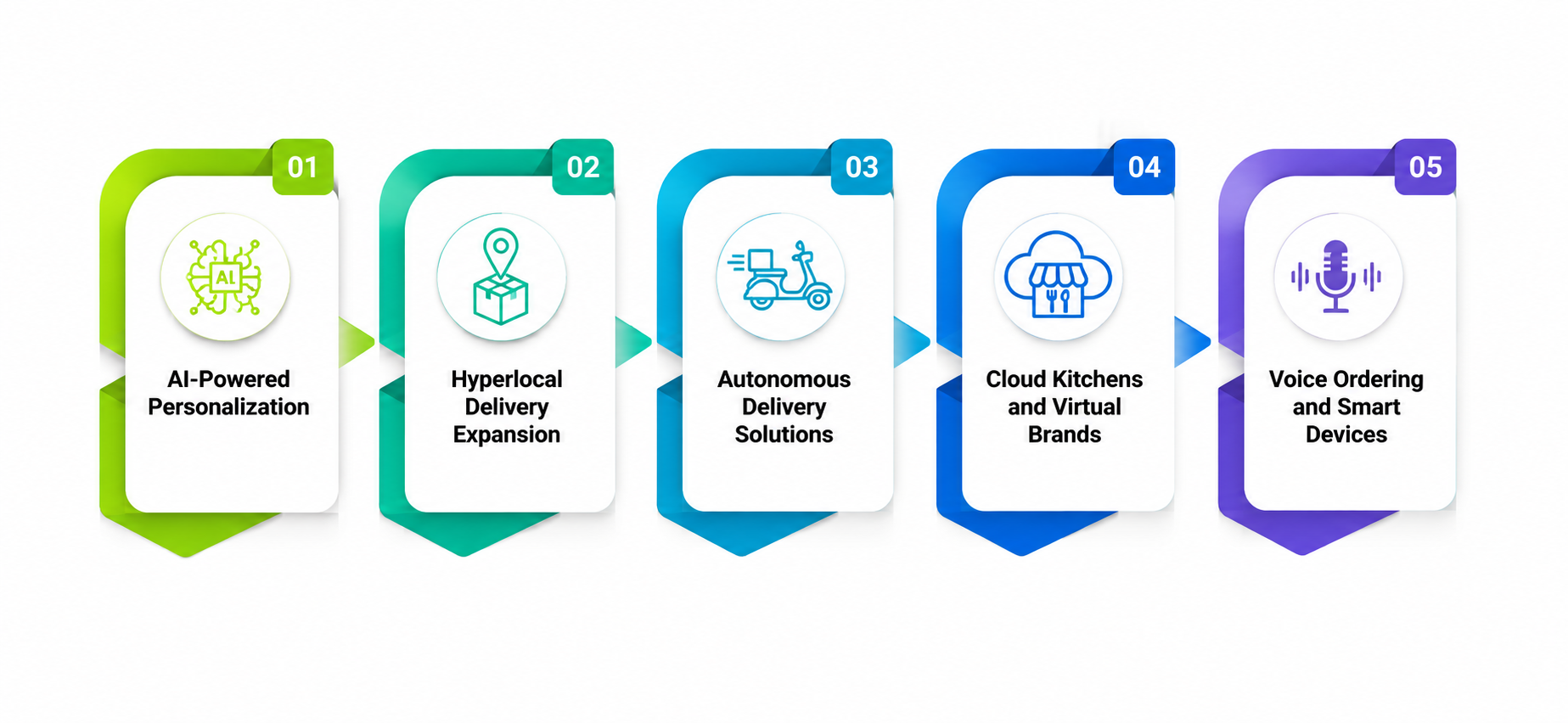
1. AI-Powered Personalization
Artificial Intelligence will analyze customer preferences, ordering history, dietary habits, and purchasing behavior to recommend personalized meals, offers, and restaurants, improving user engagement and increasing repeat orders.
2. Hyperlocal Delivery Expansion
Businesses will continue expanding hyperlocal delivery networks, enabling customers to receive meals, groceries, medicines, and daily essentials within minutes through optimized logistics and localized delivery hubs.
3. Autonomous Delivery Solutions
Drones, autonomous vehicles, and robotic delivery systems are expected to reduce delivery costs, improve efficiency, and enable faster deliveries in urban environments as regulations continue to evolve.
4. Cloud Kitchens and Virtual Brands
Cloud kitchens will become increasingly popular due to lower operational costs and higher profitability. Food delivery platforms will continue supporting multiple virtual restaurant brands operating from a single kitchen.
5. Voice Ordering and Smart Devices
Voice assistants and smart home devices will allow customers to place food orders using simple voice commands, creating a more convenient and hands-free ordering experience.
Conclusion
The success of platforms like Swiggy demonstrates the enormous potential of the online food delivery industry. As customer expectations continue to evolve, businesses need intelligent, scalable, and feature-rich applications that deliver seamless ordering experiences, efficient restaurant management, and reliable delivery operations.
Developing a food delivery app is more than building a mobile application, it involves creating a complete digital ecosystem that connects customers, restaurants, delivery partners, and administrators through secure, real-time technology. While the development cost depends on the application's complexity, investing in the right features, modern technologies, and scalable architecture lays the foundation for sustainable business growth.
At OZVID Technologies, we specialize in building high-performance online food delivery applications tailored to your business objectives. From MVP development to enterprise-grade apps with AI-powered features, real-time tracking, secure payment integrations, and cloud-native infrastructure, our experienced development team delivers scalable solutions that help businesses launch faster, improve customer engagement, and stay ahead of the competition.
Whether you're a startup or an established enterprise, we can turn your food delivery app idea into a successful digital product. Contact us to learn more.
Frequently Asked Questions
1. How much does it cost to build an app like Swiggy?
The development cost typically ranges from $20,000 to $150,000+, depending on the application's complexity, supported platforms, feature set, technology stack, integrations, and customization requirements.
2. How long does it take to develop a food delivery app?
A basic food delivery application may take 3–5 months, while a feature-rich platform with customer, restaurant, delivery, and admin modules generally requires 7–14 months to design, develop, test, and deploy.
3. What are the essential features of a Swiggy-like app?
Core features include user registration, restaurant listings, menu management, online payments, GPS tracking, push notifications, order history, ratings and reviews, delivery partner management, restaurant dashboards, and an admin panel.
4. Which technologies are best for developing a food delivery application?
Popular technologies include Flutter, React Native, Node.js, Laravel, Python, Firebase, AWS, Google Maps API, Stripe, Razorpay, and MySQL/PostgreSQL, depending on project requirements.
5. How do food delivery apps generate revenue?
Revenue streams include:
- Restaurant commission fees
- Delivery charges
- Subscription plans
- Featured restaurant listings
- In-app advertisements
- Convenience fees
- Surge pricing during peak demand
6. Can I start with an MVP before building a full-scale platform?
Yes. Launching a Minimum Viable Product (MVP) helps validate your business idea, attract early users, gather customer feedback, and reduce initial development costs before investing in advanced features.
7. Why should I choose OZVID Technologies for food delivery app development?
OZVID Technologies offers end-to-end food delivery app development services, including business consulting, UI/UX design, mobile and web development, cloud deployment, AI integration, quality assurance, and post-launch maintenance. Our scalable solutions are designed to help businesses accelerate growth and deliver exceptional user experiences.