Key Takeaways
- AI sales agents automate repetitive sales activities such as lead qualification, outreach, follow-ups, and customer engagement.
- Businesses can use AI sales agents to provide personalized interactions across websites, email, messaging platforms, and CRM systems.
- AI sales agent development involves planning, data preparation, AI model selection, conversation design, integration, and deployment.
- Development costs depend on features, integrations, AI model complexity, security requirements, and customization.
- Intelligent sales agents can improve response times, reduce manual workload, and help sales teams focus on high-value opportunities.
- Businesses should prioritize data security, human oversight, personalization, and scalable architecture when developing AI sales agents.
Sales teams are increasingly turning to artificial intelligence to manage growing customer expectations, large volumes of leads, and repetitive sales activities. Traditional sales processes often require representatives to spend significant time on prospect research, lead qualification, follow-ups, appointment scheduling, and answering recurring questions. AI sales agents can automate many of these activities while delivering personalized interactions at scale.
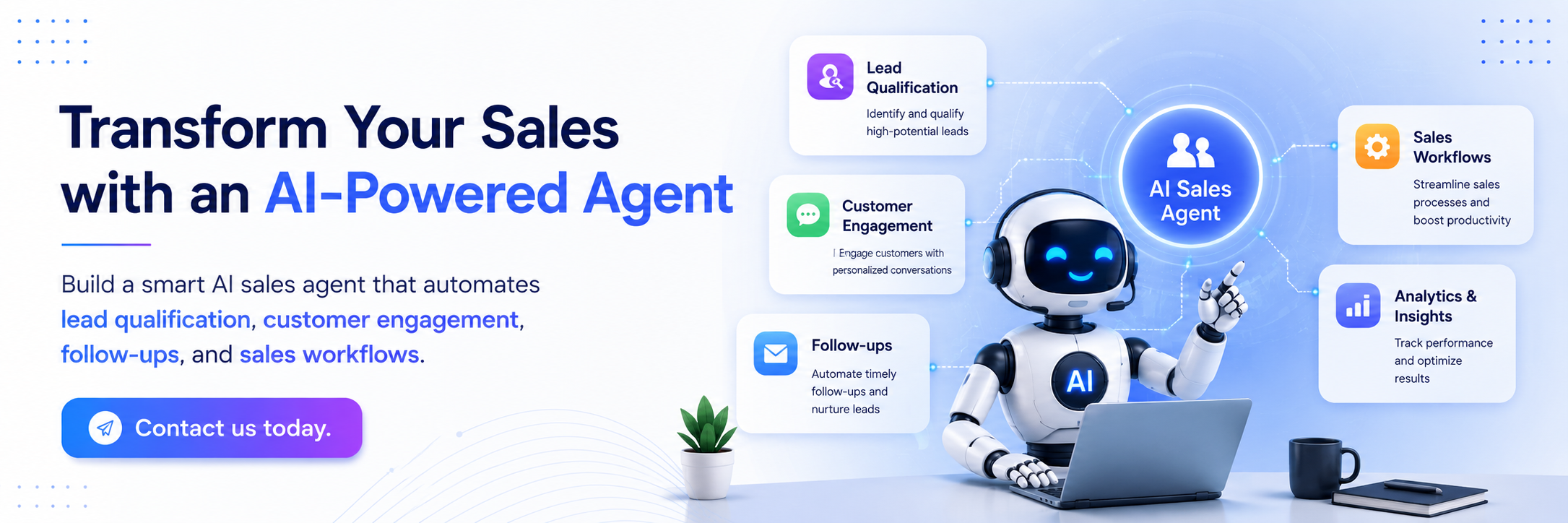
An AI sales agent is an intelligent software system designed to perform sales-related tasks using technologies such as artificial intelligence, machine learning, natural language processing, generative AI, and customer data analytics. Unlike basic automation tools that follow fixed rules, AI sales agents can understand customer intent, analyze information, generate responses, recommend products, qualify leads, and determine appropriate next actions.
With the right development strategy, an AI sales agent can become an intelligent extension of a sales team. It can engage prospects 24/7, respond quickly to inquiries, maintain consistent communication, and transfer qualified opportunities to human representatives when required.
For businesses looking to modernize their sales operations, AI sales agent development offers an opportunity to create faster, more responsive, and data-driven sales processes.
AI Sales Agent Market: Growth Driving Business Adoption
The growing adoption of AI across sales and customer engagement is creating strong demand for intelligent sales technologies. According to the market statistics provided, the global AI sales agent market is predicted to reach approximately USD 130.79 billion by 2034, registering a 44.7% CAGR throughout the forecast period.
This rapid growth highlights the increasing interest in AI-powered sales automation. Businesses are investing in AI agents to improve lead management, accelerate customer responses, personalize communication, and support sales representatives with intelligent insights.
As AI models become more capable, sales agents are also moving beyond simple chatbots. Modern solutions can connect with CRM platforms, analyze customer behavior, recommend next steps, generate personalized messages, and coordinate multiple stages of the sales funnel.
Why Businesses Are Investing in AI Sales Agents
AI sales agents are becoming an important part of modern sales strategies because they can automate repetitive activities while maintaining continuous engagement with prospects. By combining customer data, conversational AI, automation, and analytics, businesses can create faster, more personalized, and data-driven sales processes. The key benefits include:
- 24/7 Customer Engagement: AI sales agents can interact with prospects around the clock, including evenings, weekends, and holidays. They can instantly answer common questions, provide product information, collect lead details, and guide potential customers toward the next step without requiring a sales representative to be available.
- Faster Lead Qualification: AI agents can engage incoming prospects immediately and ask relevant qualification questions based on predefined sales criteria. They can evaluate responses, identify high-potential leads, gather essential information, and prioritize opportunities, helping sales teams focus their time on prospects with stronger purchase intent.
- Personalized Communication: AI sales agents can use customer profiles, previous interactions, preferences, browsing behavior, and conversation history to deliver more relevant responses. Personalized communication helps businesses create meaningful customer experiences while making product recommendations, offers, and sales messages more aligned with individual customer requirements.
- Automated Follow-Ups: Consistent follow-ups are essential for converting prospects, but manually tracking every lead can be challenging for sales teams. AI agents can automatically send reminders, emails, messages, and relevant information based on customer actions, helping businesses maintain engagement and reduce the chances of missed opportunities.
- Reduced Sales Team Workload: AI agents can handle repetitive activities such as answering frequently asked questions, collecting customer information, scheduling meetings, updating records, and conducting initial qualification. This allows sales representatives to spend more time on strategic activities such as negotiations, relationship building, personalized consultations, and closing deals.
- Better Sales Insights: AI sales agents can analyze customer conversations, questions, responses, engagement patterns, and lead behavior to generate valuable sales insights. Businesses can use these insights to identify common customer concerns, understand buying intent, improve sales strategies, recognize emerging opportunities, and optimize their overall sales funnel.
- Improved Response Time: Customers increasingly expect quick responses when researching products or services. AI sales agents can respond within seconds, reducing waiting times and ensuring prospects receive relevant information while their interest is still high. Faster engagement can help businesses create smoother customer journeys and improve lead conversion opportunities.
- Scalable Sales Operations: As the number of leads increases, expanding a traditional sales team can require significant time and resources. AI sales agents can handle multiple conversations simultaneously, allowing businesses to manage higher volumes of prospects without proportionally increasing their operational workload. This makes AI particularly valuable for growing businesses and high-volume sales environments.
Building an Intelligent AI Sales Agent: A Step-by-Step Development Process
Developing an AI sales agent requires more than connecting a language model to a chatbot interface. Businesses need to define sales objectives, design intelligent workflows, prepare relevant data, integrate business systems, and establish safeguards. A structured development process ensures that the agent remains accurate, useful, secure, scalable, and aligned with the organization's sales strategy.

1. Define Sales Objectives and Use Cases
The first step is identifying exactly what the AI sales agent should accomplish. Businesses may want an agent for lead qualification, outbound outreach, product recommendations, appointment booking, customer queries, follow-ups, or complete sales assistance. Clearly defined objectives help determine the required features and technical architecture.
- Identify repetitive sales activities.
- Define target customer segments.
- Establish measurable sales goals.
- Determine when human intervention is required.
2. Collect and Prepare Sales Data
AI sales agents depend on high-quality business information to deliver useful responses. Developers collect product catalogs, FAQs, pricing information, sales scripts, CRM records, customer profiles, and relevant knowledge-base content. The information is then cleaned, structured, categorized, and prepared for AI processing.
- Organize product and service information.
- Clean duplicate or outdated data.
- Structure customer and lead information.
- Establish data access and governance rules.
3. Select the AI Technology Stack
The appropriate AI technology depends on the agent's objectives and complexity. Developers may use large language models, natural language processing, retrieval-augmented generation, machine learning models, speech technologies, vector databases, and automation frameworks. The architecture should balance intelligence, performance, cost, scalability, and security.
- Select suitable AI and language models.
- Choose databases and knowledge repositories.
- Define APIs and integration frameworks.
- Plan infrastructure and scalability requirements.
4. Design Sales Conversations and Workflows
Conversation design determines how the AI agent communicates with prospects. Developers create conversation flows for greetings, qualification, product discovery, objections, recommendations, follow-ups, and escalation. The agent should understand context and maintain conversation continuity instead of responding as an isolated question-answer system.
- Create sales conversation flows.
- Define qualification questions.
- Build objection-handling scenarios.
- Design human handoff workflows.
5. Develop and Integrate the AI Agent
Once the architecture and workflows are finalized, developers build the AI sales agent and connect it with essential business systems. CRM, email, calendars, communication platforms, payment systems, analytics tools, and customer databases can be integrated to allow the agent to perform meaningful sales actions.
- Integrate CRM and customer databases.
- Connect email and messaging channels.
- Enable calendar and appointment scheduling.
- Implement required APIs and business workflows.
6. Train, Test, and Optimize the Agent
Testing ensures that the agent responds accurately and behaves appropriately across different customer scenarios. Developers evaluate conversations, test edge cases, identify incorrect responses, and improve prompts, knowledge retrieval, workflows, and escalation mechanisms. Continuous optimization helps the agent become more reliable as real-world usage increases.
- Test common and unexpected queries.
- Measure response accuracy.
- Evaluate lead qualification performance.
- Refine prompts and knowledge retrieval.
7. Deploy, Monitor, and Improve
After successful testing, the AI sales agent is deployed across selected channels. Monitoring tools track conversations, response quality, conversion-related metrics, errors, and system performance. Businesses can use these insights to continuously improve the agent's knowledge, workflows, personalization, and overall sales effectiveness.
- Monitor agent performance continuously.
- Track sales and engagement metrics.
- Review conversations for quality.
- Introduce improvements based on real-world data.
How Much Does It Cost to Develop an AI Sales Agent?
The cost of developing an AI sales agent varies significantly based on its intelligence, integrations, interface, AI model, automation capabilities, security requirements, and deployment environment. A basic agent focused on FAQs and lead qualification requires less investment than a sophisticated enterprise agent connected with multiple systems and capable of executing complex sales workflows.
AI Sales Agent Type | Estimated Development Cost | Typical Development Time |
Basic AI Sales Chatbot | $8,000–$15,000 | 4–8 weeks |
Lead Qualification Agent | $15,000–$30,000 | 6–10 weeks |
AI Outreach & Follow-Up Agent | $25,000–$45,000 | 8–14 weeks |
CRM-Integrated Sales Agent | $30,000–$60,000 | 10–16 weeks |
Advanced Multi-Channel AI Sales Agent | $50,000–$90,000+ | 14–22 weeks |
Enterprise AI Sales Agent | $90,000–$150,000+ | 20–30+ weeks |
These figures are indicative rather than fixed. Costs can increase when businesses require custom AI models, voice capabilities, advanced analytics, multilingual support, complex CRM integrations, enterprise-grade security, or extensive automation.
Key Factors Influencing Development Cost
Several factors determine the final investment:
- AI model: Using a third-party AI API may reduce initial development costs, while customized models can require greater investment.
- Features: Lead scoring, recommendations, automated outreach, voice interaction, analytics, and autonomous task execution increase complexity.
- Integrations: CRM, ERP, email, calendar, communication, payment, and marketing integrations require additional development.
- Security: Data encryption, authentication, access controls, compliance, and monitoring can increase development requirements.
- Platform: Web, mobile, messaging, voice, and omnichannel deployments affect overall development scope.
From Concept to Deployment: How Long Does AI Sales Agent Development Take?
The development timeline depends on the agent's functionality and technical complexity. A simple AI sales assistant can be developed within several weeks, while an enterprise-grade solution with sophisticated workflows, multiple integrations, custom AI capabilities, and extensive testing can take several months. Proper planning helps minimize delays and ensures reliable deployment.
Development Stage | Estimated Time | Key Activities |
|---|---|---|
Planning & Requirement Analysis | 1–2 Weeks | Define objectives, features, sales workflows, target users, KPIs, and integration requirements. |
Data Preparation & AI Architecture | 1–3 Weeks | Prepare business data, product information, FAQs, select AI models, databases, APIs, and infrastructure. |
AI Agent Development & Integration | 4–10 Weeks | Develop AI workflows, conversational interfaces, automation features, business logic, and CRM/API integrations. |
Testing & Quality Assurance | 2–4 Weeks | Test conversations, AI accuracy, integrations, security, performance, edge cases, and human handoffs. |
Deployment & Optimization | Ongoing | Deploy the agent, monitor performance, analyze conversations, update knowledge, and continuously optimize workflows. |
Overall Development Time | 4–30+ Weeks | Timeline varies based on features, AI complexity, integrations, customization, and enterprise requirements. |
Best Practices for Developing High-Performing AI Sales Agents
A successful AI sales agent should not simply sound conversational, it should generate measurable business value while maintaining accuracy, security, and customer trust. Businesses should combine strong AI architecture with thoughtful sales strategy, human oversight, high-quality data, and continuous optimization to build an agent that can scale with changing business needs.

1. Start With a Clearly Defined Sales Objective
Avoid developing an AI agent without a specific business purpose. Identify whether the primary goal is lead qualification, appointment scheduling, outbound engagement, product recommendations, customer support, or sales assistance. A focused initial use case makes development easier to measure and optimize.
2. Prioritize Personalization
Generic responses can reduce customer engagement. AI sales agents should use relevant customer information, previous interactions, preferences, purchase history, and conversation context to create meaningful interactions. Personalization should remain relevant and transparent while respecting data privacy and applicable organizational policies.
3. Keep Humans in the Loop
AI should support sales representatives rather than eliminate human judgment from important interactions. Complex negotiations, sensitive customer issues, high-value opportunities, and situations outside the agent's capabilities should be transferred to human representatives smoothly.
4. Integrate the Agent With Business Systems
An isolated AI agent has limited value. Connecting it with CRM, marketing automation, calendars, customer databases, analytics tools, and communication platforms allows it to access relevant information and execute useful actions.
5. Focus on Security and Responsible AI
Sales agents may process customer information, business data, and confidential conversations. Security should therefore be considered throughout development. Access controls, encryption, secure APIs, monitoring, data governance, and appropriate privacy practices help reduce potential risks.
Conclusion
AI sales agents are changing how businesses approach prospect engagement, lead qualification, follow-ups, and sales automation. By combining conversational AI, machine learning, business data, CRM integrations, and intelligent workflows, organizations can create sales systems capable of operating continuously while delivering more personalized customer experiences.
However, successful AI sales agent development requires more than selecting an AI model. Businesses need a clear strategy, reliable data, thoughtful conversation design, secure integrations, human oversight, comprehensive testing, and continuous optimization.
At OZVID Technologies, we help businesses transform sales operations with customized AI-powered solutions designed around their specific workflows and objectives. From AI strategy and agent development to integrations, deployment, and ongoing optimization, our team can help you build intelligent sales solutions that support sustainable business growth.
Ready to transform your sales process with intelligent automation? Partner with OZVID Technologies to build a powerful AI sales agent tailored to your business needs.
Frequently Asked Questions
1. How does an AI sales agent improve sales operations?
An AI sales agent helps businesses streamline repetitive sales activities while improving customer engagement. It can:
- Respond to prospects quickly and provide instant assistance.
- Automate repetitive sales and administrative tasks.
- Identify and prioritize qualified leads.
- Personalize customer conversations using relevant data.
- Maintain consistent follow-ups throughout the sales journey.
- Allow sales representatives to focus on negotiations and high-value opportunities.
2. How much does it cost to develop an AI sales agent?
AI sales agent development can range from approximately $8,000 for a basic solution to $150,000 or more for an advanced enterprise platform. The cost depends on:
- Number and complexity of required features.
- AI model and technology requirements.
- CRM and third-party integrations.
- Security and data protection requirements.
- Customization and automation needs.
- Platform, infrastructure, and ongoing maintenance requirements.
3. How long does it take to develop an AI sales agent?
A basic AI sales agent may take around 4–8 weeks, while advanced enterprise solutions can require several months. The development timeline depends on:
- Number of features and sales workflows.
- AI model and conversational complexity.
- CRM and third-party integrations.
- Data preparation and training requirements.
- Testing and quality assurance.
- Deployment and scalability requirements.
4. Can an AI sales agent integrate with a CRM?
Yes, AI sales agents can integrate with CRM platforms to streamline sales processes and centralize customer information. They can:
- Access relevant customer and lead information.
- Automatically update lead records.
- Track customer interactions and conversations.
- Qualify and categorize prospects.
- Schedule sales activities and appointments.
- Provide sales teams with relevant customer insights.
5. Can AI sales agents handle multiple communication channels?
Yes. Depending on the development requirements, an AI sales agent can operate across multiple communication channels. These may include:
- Business websites and web applications.
- Mobile applications.
- Email communication.
- Messaging and chat platforms.
- Voice and conversational interfaces.
- Other customer engagement channels through API integrations.
6. Why should businesses choose custom AI sales agent development?
Custom AI sales agent development allows businesses to create a solution specifically aligned with their sales processes and customer requirements. Key advantages include:
- Customized sales workflows and automation.
- Integration with existing CRM and business systems.
- Personalized customer journeys and conversations.
- Greater control over data and security.
- Flexible architecture for future scalability.
- Ability to add new AI capabilities as business requirements evolve.