
The banking industry is undergoing a major digital transformation, and Artificial Intelligence (AI) is at the center of this evolution. From automating routine operations and enhancing customer experiences to improving fraud detection and risk management, AI is helping financial institutions become more efficient, secure, and customer-focused. As customer expectations continue to rise, banks are increasingly adopting AI-powered technologies to deliver faster, smarter, and more personalized financial services.
The rapid growth of AI adoption in the banking sector is reflected in market projections. The global artificial intelligence in banking market size is expected to reach USD 143.56 billion by 2030, growing at a remarkable CAGR of 31.8% from 2024 to 2030. This significant growth highlights the increasing reliance on AI technologies to streamline operations, enhance decision-making, strengthen cybersecurity, and drive innovation across the financial services industry.
AI-powered digital banking solutions leverage technologies such as machine learning, natural language processing, predictive analytics, robotic process automation, and big data analytics to transform traditional banking processes. These intelligent systems enable banks to analyze massive volumes of data, provide personalized recommendations, automate customer interactions, and identify potential risks in real time.
Key Takeaways
- AI is transforming digital banking by improving efficiency, customer experiences, and decision-making.
- AI-powered chatbots and virtual assistants provide instant customer support around the clock.
- Machine learning algorithms help banks detect fraud and mitigate financial risks more effectively.
- AI enables personalized banking experiences through customer behavior analysis and predictive insights.
- The cost of implementing AI in banking varies depending on features, complexity, infrastructure, and compliance requirements.
- Emerging technologies such as generative AI, predictive analytics, and hyper-personalization will shape the future of digital banking.
Understanding AI in Digital Banking
AI in digital banking refers to the use of advanced technologies such as machine learning, natural language processing, predictive analytics, computer vision, and robotic process automation to enhance banking operations and customer services. These technologies enable banks to automate repetitive tasks, analyze large datasets, detect patterns, and make intelligent decisions in real time.
Traditional banking systems often rely on manual processes and rule-based workflows, which can limit efficiency and responsiveness. AI introduces intelligent automation that allows financial institutions to streamline operations while reducing errors and operational costs.
Banks utilize AI across multiple functions, including customer service, fraud prevention, loan processing, credit scoring, investment management, compliance monitoring, and personalized financial recommendations. By leveraging AI, financial institutions can deliver more accurate, efficient, and customer-centric services while remaining competitive in a rapidly evolving digital landscape.
AI-powered Digital Banking: Working Process
AI-powered digital banking combines advanced technologies such as machine learning, natural language processing, predictive analytics, and automation to deliver intelligent, secure, and personalized banking experiences. The process involves collecting customer data, analyzing information in real time, generating actionable insights, and continuously improving decision-making through learning algorithms. By integrating AI into banking systems, financial institutions can automate operations, enhance customer interactions, detect fraud, and provide tailored financial services more efficiently.
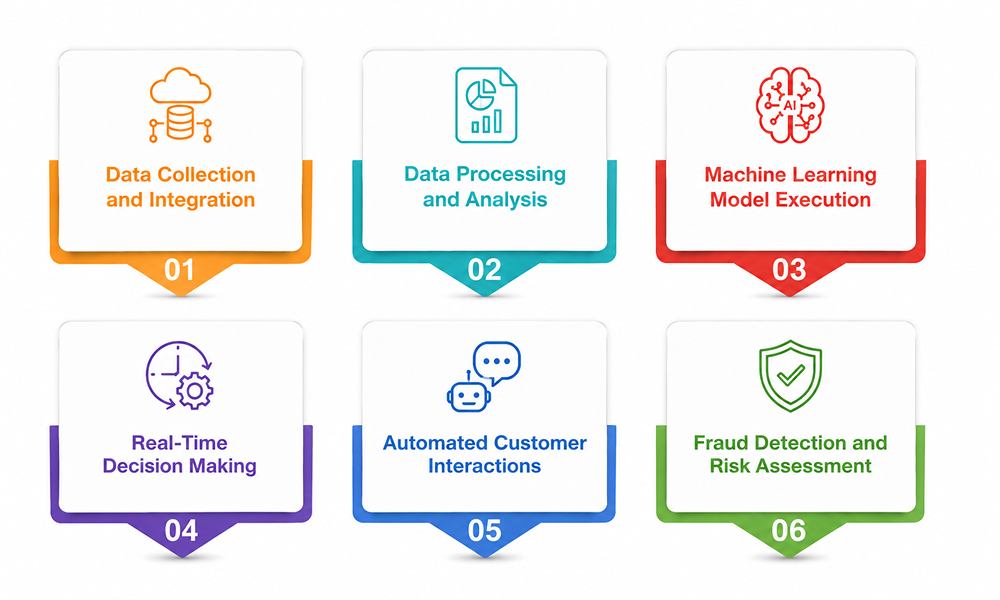
1. Data Collection and Integration
The AI-powered banking process begins with collecting data from multiple sources, including mobile banking apps, websites, transaction records, customer interactions, credit histories, and third-party financial systems. This comprehensive data serves as the foundation for AI-driven analysis and decision-making.
2. Data Processing and Analysis
Once data is collected, AI systems process and analyze it using advanced algorithms and machine learning models. These technologies identify patterns, trends, anomalies, and relationships within large datasets that would be difficult for humans to detect manually. The analysis stage helps banks understand customer preferences, spending habits, creditworthiness, and risk factors.
3. Machine Learning Model Execution
Machine learning models use historical and real-time data to generate predictions and recommendations. These models continuously learn from new information, allowing them to improve their accuracy and performance over time without requiring constant manual intervention. Banks utilize machine learning for fraud detection, credit scoring, loan approvals, customer segmentation, and investment recommendations.
4. Real-Time Decision Making
AI systems enable real-time decision-making by instantly analyzing incoming data and generating responses based on predefined objectives and learned behaviors. This capability is critical for banking operations that require immediate action and high accuracy.
5. Automated Customer Interactions
Natural Language Processing (NLP) powers intelligent chatbots and virtual assistants that can understand customer queries and provide instant support. These AI-driven tools deliver consistent service while handling thousands of customer requests simultaneously. Customers can access account information, resolve issues, initiate transactions, and receive financial guidance without waiting for human assistance.
6. Fraud Detection and Risk Assessment
AI continuously monitors customer activities and transaction data to identify unusual behavior and potential security threats. By comparing current transactions against historical patterns, AI can detect fraud attempts before significant damage occurs. Risk assessment models evaluate credit applications, financial activities, and customer profiles to determine potential risks.
Benefits of AI-powered Digital Banking
Artificial Intelligence is transforming digital banking by enabling financial institutions to deliver faster services, improve operational efficiency, strengthen security measures, and create highly personalized customer experiences.
1. Enhanced Customer Experience
AI enables banks to understand customer preferences, behaviors, and financial needs more effectively. Through personalized recommendations, instant support, and seamless interactions across multiple channels, financial institutions can provide a more engaging and customer-centric banking experience. AI-driven systems continuously analyze customer data to tailor services and deliver relevant financial solutions. This level of personalization helps strengthen customer relationships and improves overall satisfaction.
Benefits:
- Personalized financial recommendations
- Faster customer support responses
- Improved customer engagement
- Consistent omnichannel experiences
2. Improved Fraud Detection and Prevention
AI-powered fraud detection systems monitor transactions and account activities around the clock to identify suspicious behavior. By analyzing patterns and anomalies in real time, these systems can detect potential threats before they result in significant financial losses. Unlike traditional rule-based security systems, AI continuously learns from new fraud patterns and adapts to emerging threats. This proactive approach enhances security and protects both customers and financial institutions.
Benefits:
- Real-time transaction monitoring
- Early fraud identification
- Reduced financial losses
- Stronger cybersecurity protection
3. Faster Loan and Credit Processing
AI significantly accelerates loan approvals and credit assessments by automating data collection, verification, and risk evaluation processes. Financial institutions can process applications more efficiently while maintaining high levels of accuracy. Machine learning algorithms evaluate customer profiles, credit histories, and financial records within minutes, reducing delays and improving the overall lending experience for applicants.
Benefits:
- Quicker loan approvals
- Automated credit evaluations
- Reduced paperwork requirements
- Improved lending accuracy
4. Increased Operational Efficiency
AI automates repetitive and time-consuming tasks, allowing banking employees to focus on higher-value activities. Automation streamlines workflows, reduces manual intervention, and improves productivity across various departments. From transaction processing to compliance management, AI-driven automation helps banks optimize operations while lowering administrative costs and minimizing human errors.
Benefits:
- Reduced operational expenses
- Higher employee productivity
- Faster process execution
- Improved workflow management
5. Data-Driven Decision Making
AI enables banks to analyze large volumes of structured and unstructured data to uncover valuable insights. These insights support strategic planning, customer segmentation, risk management, and product development initiatives. Advanced analytics tools help financial institutions make informed decisions based on real-time information rather than assumptions, leading to improved business outcomes.
Benefits:
- Better forecasting accuracy
- Enhanced business intelligence
- Improved strategic planning
- Smarter financial decisions
6. Personalized Financial Services
AI helps banks deliver customized products and services tailored to individual customer needs. By analyzing spending patterns, income levels, and financial goals, AI can recommend relevant solutions that improve customer engagement. Personalized banking experiences create stronger customer relationships and increase the likelihood of long-term loyalty and product adoption.
Benefits:
- Customized product recommendations
- Tailored investment suggestions
- Personalized savings plans
- Improved customer satisfaction
Core Components of AI-Powered Digital Banking Software
AI-powered digital banking relies on a combination of advanced technologies and intelligent systems that work together to deliver secure, efficient, and personalized financial services. These core components enable banks to automate operations, analyze vast amounts of data, enhance customer interactions, and make real-time decisions.
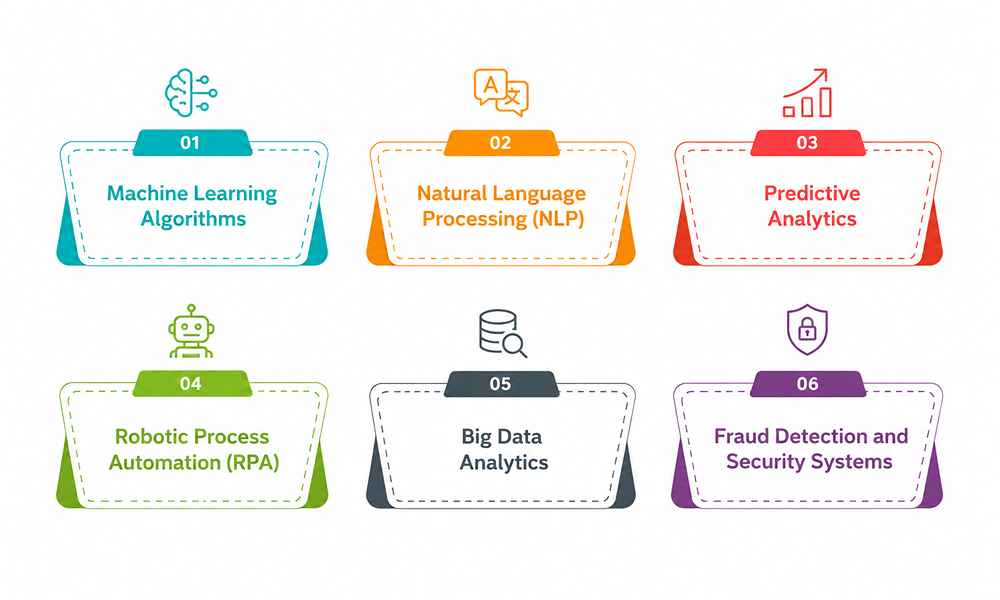
1. Machine Learning Algorithms
Machine learning serves as the foundation of AI-powered banking by enabling systems to learn from historical and real-time data. These algorithms identify patterns, make predictions, and continuously improve their accuracy without requiring constant manual intervention. Banks use machine learning to automate decision-making processes, improve risk assessment, and enhance customer experiences. The technology helps financial institutions uncover valuable insights that support smarter and faster business decisions.
Key Functions:
- Fraud detection and prevention
- Credit scoring and loan approvals
- Customer behavior analysis
- Predictive financial modeling
2. Natural Language Processing (NLP)
Natural Language Processing enables banking systems to understand, interpret, and respond to human language. This technology powers chatbots, virtual assistants, and voice-enabled banking services that provide instant customer support. NLP enhances communication between banks and customers by automating interactions while maintaining a conversational and user-friendly experience. It helps financial institutions improve service quality and reduce response times.
Key Functions:
- AI-powered chatbots
- Voice banking services
- Customer query resolution
- Sentiment analysis
3. Predictive Analytics
Predictive analytics uses historical and current data to forecast future outcomes, customer behaviors, and financial trends. Banks leverage predictive models to anticipate customer needs and make proactive business decisions. By identifying opportunities and risks before they occur, predictive analytics enables financial institutions to improve planning, optimize resources, and deliver more relevant financial products and services.
Key Functions:
- Customer behavior prediction
- Financial forecasting
- Revenue optimization
- Risk identification
4. Robotic Process Automation (RPA)
Robotic Process Automation automates repetitive and rule-based banking tasks that traditionally require manual effort. RPA improves operational efficiency by executing routine processes quickly and accurately. Banks utilize RPA to streamline administrative workflows, reduce operational costs, and improve productivity. Automation minimizes human errors while ensuring faster processing of banking activities.
Key Functions:
- Data entry automation
- Account management tasks
- Compliance reporting
- Transaction processing
5. Big Data Analytics
Big Data Analytics enables financial institutions to process and analyze massive volumes of structured and unstructured information from various sources. This component helps banks gain valuable insights into customer behavior and market trends. The ability to analyze large datasets allows banks to improve strategic decision-making, personalize services, and identify growth opportunities while maintaining operational efficiency.
Key Functions:
- Customer data analysis
- Market trend identification
- Business intelligence generation
- Customer segmentation
6. Fraud Detection and Security Systems
AI-powered security systems continuously monitor transactions and account activities to identify suspicious patterns and potential threats. These systems play a crucial role in protecting financial assets and customer information. Advanced fraud detection solutions leverage machine learning and behavioral analytics to recognize anomalies and respond to security risks in real time.
Key Functions:
- Transaction monitoring
- Anomaly detection
- Identity verification
- Cybersecurity protection
AI-powered Digital Banking Cost Analysis
The cost of developing an AI-powered digital banking solution depends on several factors, including the complexity of features, AI capabilities, security requirements, regulatory compliance standards, third-party integrations, deployment infrastructure, and customization needs. Financial institutions may choose to implement individual AI modules such as chatbots or fraud detection systems, or develop a comprehensive AI-powered banking ecosystem.
Project costs also vary based on the technology stack, cloud infrastructure, development team location, data management requirements, and ongoing maintenance needs. While initial investments can be significant, AI-powered banking solutions often deliver substantial long-term returns through operational efficiency, reduced fraud losses, improved customer experiences, and increased revenue opportunities.
Cost Component | Description | Estimated Cost (USD) |
|---|---|---|
Business Analysis & Planning | Requirement gathering, market research, project planning, and AI strategy development. | $10,000 – $25,000 |
UI/UX Design | Designing intuitive customer interfaces for web and mobile banking applications. | $8,000 – $20,000 |
AI Model Development | Building and training machine learning models for banking operations and analytics. | $30,000 – $75,000 |
Natural Language Processing (NLP) Integration | Developing chatbots, virtual assistants, and conversational banking features. | $15,000 – $60,000 |
Fraud Detection System | AI-powered transaction monitoring and fraud prevention mechanisms. | $20,000 – $100,000 |
Predictive Analytics Engine | Customer behavior analysis, forecasting, and recommendation systems. | $15,000 – $75,000 |
Core Banking System Integration | Connecting AI modules with existing banking platforms and databases. | $20,000 – $80,000 |
API Development & Third-Party Integrations | Payment gateways, fintech services, CRM systems, and external financial tools. | $10,000 – $50,000 |
Cloud Infrastructure Setup | Cloud hosting, storage, computing resources, and deployment environments. | $10,000 – $40,000 |
The Future of AI-Powered Digital Banking: Emerging Trends and Innovations
As artificial intelligence continues to evolve, digital banking is entering a new era of innovation, automation, and hyper-personalization. Financial institutions are increasingly investing in AI technologies to enhance customer experiences, strengthen security, improve operational efficiency, and create new revenue opportunities.
1. Personalized Banking Experiences
AI will enable banks to offer highly customized financial products and services tailored to individual customer preferences, spending habits, and financial goals. By leveraging advanced analytics and behavioral data, financial institutions will create more meaningful and relevant customer experiences.
2. Generative AI for Customer Service
Generative AI technologies will transform customer interactions by providing more natural, human-like conversations through virtual assistants and chatbots. These systems will be capable of handling complex customer inquiries, offering financial guidance, and delivering personalized recommendations with greater accuracy.
3. Advanced Fraud Detection
Future AI systems will become even more effective at identifying sophisticated fraud attempts and cyber threats in real time. Continuous monitoring, behavioral analysis, and predictive threat intelligence will help banks strengthen security frameworks and minimize financial risks.
4. Financial Advisory Services
Digital banking platforms will increasingly incorporate AI-driven financial advisors capable of providing investment recommendations, wealth management guidance, retirement planning, and budgeting support. These services will make financial expertise more accessible to a broader customer base.
5. Voice and Conversational Banking
Voice-enabled banking solutions will continue to gain popularity as customers seek more convenient ways to manage their finances. AI-powered voice assistants will allow users to perform transactions, check balances, receive alerts, and access financial information using simple voice commands.
6. Open Banking and Intelligent Ecosystems
The integration of AI with open banking frameworks will create highly connected financial ecosystems. Banks will collaborate with fintech companies and third-party providers to deliver innovative services, enhance customer experiences, and unlock new business opportunities.
Conclusion
Artificial Intelligence is rapidly transforming the digital banking landscape by enabling financial institutions to deliver smarter, faster, and more personalized financial services. From intelligent customer support and fraud prevention to predictive analytics and automated decision-making, AI is helping banks improve operational efficiency while enhancing customer satisfaction and security.
At OZVID Technologies, we specialize in developing innovative AI-powered digital banking solutions that help financial institutions accelerate digital transformation and drive sustainable growth. Our expertise in artificial intelligence, machine learning, cloud technologies, fintech development, and enterprise software engineering enables us to build secure, scalable, and future-ready banking platforms tailored to your business needs. Whether you're looking to implement AI-driven customer experiences, enhance fraud detection capabilities, or modernize your banking infrastructure, our team is committed to delivering cutting-edge solutions that empower your organization for long-term success. Contact us to learn more.
Frequently Asked Questions
1. Why should banks invest in AI-powered digital banking solutions?
AI-powered digital banking solutions help financial institutions improve efficiency, reduce operational costs, strengthen security, and enhance customer experiences. By automating routine processes and leveraging data-driven insights, banks can stay competitive in a rapidly evolving financial landscape.
Key Benefits:
- Improved operational efficiency
- Enhanced customer satisfaction
- Reduced operational costs
- Better fraud detection capabilities
2. How does AI improve customer experience in digital banking?
AI enables banks to provide personalized services, instant customer support, and tailored financial recommendations. By analyzing customer behavior and preferences, AI helps create seamless and engaging banking experiences across multiple digital channels.
Key Benefits:
- Personalized product recommendations
- 24/7 customer support
- Faster query resolution
- Improved customer engagement
- Consistent omnichannel experiences
3. What are the primary business applications of AI in digital banking?
AI can be implemented across various banking functions, including customer service, fraud detection, loan processing, compliance management, predictive analytics, and financial advisory services. These applications help streamline operations and improve business performance.
Key Applications:
- AI-powered chatbots and virtual assistants
- Fraud detection and prevention
- Automated loan approvals
- Credit risk assessment
- Predictive analytics and forecasting
4. What factors affect the cost of developing an AI-powered digital banking platform?
The cost of development depends on project complexity, AI functionalities, security requirements, compliance standards, integrations, cloud infrastructure, and customization needs. Larger and more advanced banking solutions typically require higher investments.
Major Cost Factors:
- AI feature complexity
- Regulatory compliance requirements
- Security and data protection measures
- Third-party integrations
- Infrastructure and maintenance needs
5. How does AI help banks strengthen security and regulatory compliance?
AI continuously monitors transactions, customer activities, and operational processes to identify potential threats and compliance issues. It helps banks reduce risks, prevent fraud, and maintain adherence to industry regulations.
Security Advantages:
- Real-time fraud detection
- Automated compliance monitoring
- Identity verification systems
- Anomaly detection capabilities
- Enhanced cybersecurity protection