Businesses today generate massive amounts of financial data from invoices, payroll, sales, taxes, procurement, and operational activities. Managing this information manually often leads to calculation mistakes, reporting delays, duplicate entries, compliance risks, and inaccurate financial decisions. As organizations continue adopting digital transformation strategies, automated financial reporting software has become a critical solution for improving financial accuracy and operational efficiency.
The growing demand for automation and data-driven decision-making is significantly driving the adoption of financial reporting systems across industries. The global Financial Reporting Software Market size is projected to reach US$ 37.37 billion by 2034. This growth reflects the increasing need for businesses to improve compliance, reduce human errors, streamline accounting workflows, and enhance financial transparency.
Key Takeaways
- Automated financial reporting software minimizes manual errors and improves data accuracy significantly.
- Real-time financial insights help businesses make faster and more strategic operational decisions.
- Automated systems simplify compliance management and reduce financial reporting risks effectively.
- Cloud-based reporting platforms improve collaboration between accounting teams and stakeholders globally.
- AI-powered analytics enhance forecasting, budgeting, and overall financial planning accuracy considerably.
- Businesses save operational costs by reducing repetitive accounting and reporting tasks efficiently.
- Custom financial dashboards improve transparency, performance tracking, and executive decision-making processes.
The Rise of AI-Powered Automated Financial Reporting Software
The rise of AI-powered automated financial reporting software is transforming how businesses manage financial operations and reporting processes. Traditional financial reporting methods often involve manual data entry, spreadsheets, and lengthy calculations, which can increase the risk of human errors and consume valuable time. With the integration of Artificial Intelligence (AI), automated financial reporting systems can now collect, analyze, and process financial data in real time with improved speed and accuracy.
AI-powered automated financial reporting software helps businesses generate detailed financial statements, balance sheets, profit and loss reports, and tax summaries automatically. These advanced systems use machine learning algorithms to identify trends, detect anomalies, and provide predictive financial insights that support better decision-making. Businesses can also improve compliance with financial regulations through automated audit trails and accurate record-keeping.
Another major advantage of automated financial reporting software is enhanced efficiency. It reduces repetitive manual tasks, streamlines workflows, and allows finance teams to focus on strategic planning rather than administrative work. Cloud-based AI financial reporting solutions also offer secure data storage, easy accessibility, and seamless integration with ERP and accounting systems.
As businesses continue to embrace digital transformation, AI-powered financial reporting software is becoming an essential tool for improving financial accuracy, operational efficiency, and business growth.
Major Benefits of Integrating AI in Automated Financial Reporting Software
1. Improved Accuracy and Reduced Errors
AI financial reporting systems minimize human errors by automating calculations, data entry, and report generation. This improves the accuracy of financial statements and reduces compliance risks.
- Eliminates manual calculation mistakes
- Reduces duplicate or missing financial entries
- Improves consistency in financial reports
- Enhances data validation and verification
- Supports accurate compliance reporting
2. Real-Time Financial Insights
AI enables businesses to access real-time financial data and analytics. Companies can monitor cash flow, expenses, profits, and other financial metrics instantly for faster decision-making.
- Provides live financial performance tracking
- Helps identify spending patterns quickly
- Supports faster business decisions
- Improves budget monitoring and forecasting
- Enables instant access to financial dashboards
3. Faster Report Generation
Automated financial reporting software powered by AI can generate detailed reports within minutes. This saves time compared to traditional manual reporting processes.
- Automates monthly and yearly financial reports
- Reduces report preparation time
- Improves workflow efficiency
- Generates reports with minimal manual effort
- Speeds up financial closing processes
4. Enhanced Compliance and Security
AI helps businesses maintain compliance with financial regulations by automatically tracking transactions, maintaining audit trails, and detecting unusual activities or fraud.
- Maintains secure financial records
- Tracks all financial transactions automatically
- Detects suspicious activities and fraud risks
- Simplifies audit preparation
- Supports regulatory compliance requirements
5. Predictive Financial Analysis
AI and machine learning algorithms can analyze historical financial data to predict future trends, helping businesses plan budgets, manage risks, and improve financial strategies.
- Forecasts future financial performance
- Identifies potential business risks
- Supports smarter budgeting decisions
- Improves long-term financial planning
- Helps businesses prepare for market changes
6. Increased Operational Efficiency
By automating repetitive financial tasks, AI reduces administrative workload and allows finance teams to focus on strategic business activities and growth planning.
- Reduces repetitive manual tasks
- Improves team productivity
- Saves operational costs and time
- Streamlines financial workflows
- Allows employees to focus on strategic tasks
7. Seamless Integration with Business Systems
AI-powered financial reporting software can easily integrate with ERP systems, accounting tools, CRM platforms, and cloud applications for centralized financial management.
- Connects with existing accounting software
- Supports centralized financial data management
- Improves data synchronization across platforms
- Enhances collaboration between departments
- Simplifies financial data accessibility
Automated Financial Reporting Software Development Process
Developing automated financial reporting software requires a strategic approach that combines financial expertise, advanced technologies, security implementation, and scalable software architecture. Businesses need reliable reporting systems that can automate accounting workflows, improve financial accuracy, ensure regulatory compliance, and provide real-time insights for decision-making.
1. Requirement Analysis
The development process begins with understanding the business requirements, operational goals, reporting challenges, and compliance expectations. Developers and business analysts collaborate with stakeholders to identify the necessary features, integrations, workflows, and reporting structures.
This stage helps define the project scope and ensures the software aligns with organizational financial processes and long-term objectives.
Key Activities:
- Understanding business goals and reporting requirements.
- Identifying accounting workflows and operational challenges.
- Defining required integrations and automation features.
- Analyzing compliance and security requirements.
2. Market Research
Before development begins, businesses analyze market trends, competitor solutions, and emerging financial technologies. This helps identify valuable features, industry standards, and opportunities for innovation.
Research ensures that the software remains competitive while meeting modern financial management expectations.
Key Activities:
- Studying industry-specific financial reporting solutions.
- Identifying advanced automation and AI features.
- Evaluating competitor strengths and weaknesses.
- Understanding user expectations and market demands.
3. System Architecture Planning
In this phase, developers design the overall software architecture and technology framework. Proper architecture planning ensures scalability, performance optimization, security, and seamless integration capabilities. The architecture defines how data flows across modules, databases, APIs, and cloud infrastructure.
Key Activities:
- Designing software structure and workflows.
- Selecting frontend and backend technologies.
- Planning database architecture and cloud infrastructure.
- Defining integration frameworks and API structures.
4. UI/UX Design
Financial reporting software must provide an intuitive and user-friendly interface for finance teams, executives, auditors, and stakeholders. UI/UX designers create dashboards, navigation structures, reporting layouts, and visualization tools for easy financial analysis. Well-designed interfaces improve user experience and operational efficiency significantly.
Key Activities:
- Designing financial dashboards and report layouts.
- Creating intuitive navigation and workflows.
- Developing responsive and mobile-friendly interfaces.
- Improving accessibility and user interaction experiences.
5. Core Feature Development
Developers begin building the core functionalities of the financial reporting system. This includes accounting modules, report generation tools, automation workflows, data synchronization systems, and analytics features. The core development phase transforms business requirements into functional software capabilities.
Key Activities:
- Building automated reporting modules.
- Developing transaction processing systems.
- Creating financial analytics and dashboard features.
- Implementing real-time data synchronization.
6. Third-Party Software Integration
Modern financial reporting platforms require integration with external systems such as ERP software, banking APIs, payroll systems, CRM platforms, invoicing applications, and tax management tools. Integrations ensure smooth data exchange and centralized financial management across business operations.
Key Activities:
- Integrating accounting and ERP software.
- Connecting banking and payment gateways.
- Synchronizing payroll and taxation systems.
- Enabling API-based third-party integrations.
7. AI and Automation Implementation
Advanced financial reporting systems use artificial intelligence and automation technologies to improve forecasting, anomaly detection, budgeting, and predictive analytics. AI integration enhances reporting accuracy and supports intelligent decision-making capabilities.
Key Activities:
- Implementing machine learning algorithms.
- Developing predictive financial analytics.
- Enabling automated reconciliation and validation.
- Creating intelligent reporting and forecasting systems.
How Do Automated Financial Reporting Systems Work?
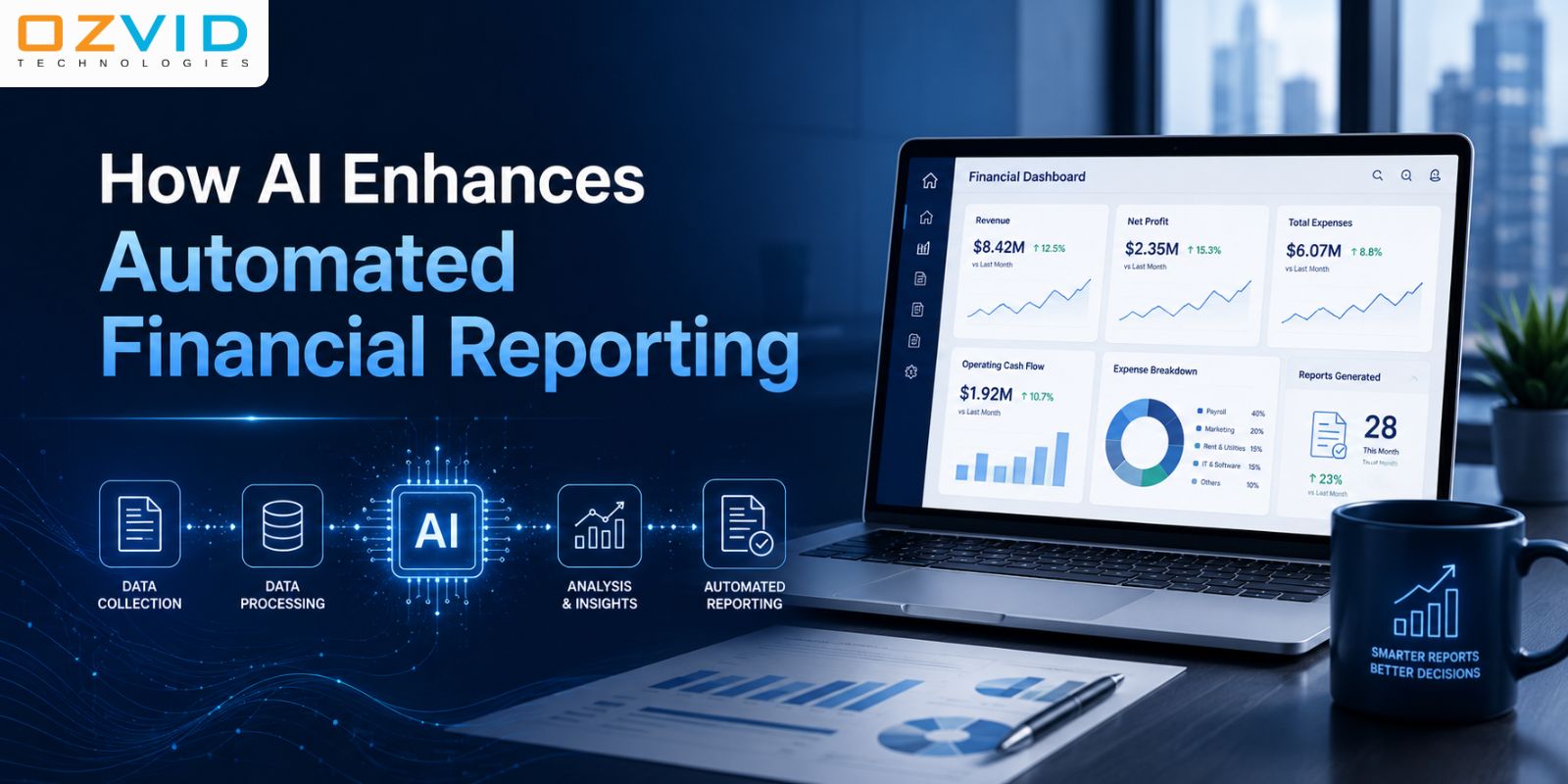
Automated financial reporting systems use advanced technologies to collect, organize, process, and present financial data automatically. These platforms integrate with multiple business applications to ensure accurate reporting, real-time insights, and streamlined financial management operations.
1. Data Collection
The software gathers financial data from accounting systems, ERP platforms, payroll applications, banking systems, and invoicing tools. Automated integration eliminates manual data transfers and ensures consistent financial information across departments.
2. Data Validation and Processing
Automated systems validate incoming financial information using predefined rules and algorithms. The software identifies inconsistencies, missing entries, and calculation errors, helping businesses maintain reliable and accurate financial records continuously.
3. Financial Data Categorization
The system automatically categorizes transactions into expenses, revenues, taxes, assets, and liabilities. Proper classification improves accounting accuracy while simplifying financial analysis, reporting processes, and regulatory compliance management significantly.
4. Real-Time Data Synchronization
Modern reporting software synchronizes financial data continuously across integrated platforms. Real-time synchronization ensures that reports always reflect updated business activities, enabling organizations to monitor financial performance without delays or discrepancies.
5. Automated Report Generation
Businesses can automatically generate financial statements, audit reports, tax summaries, and forecasting documents. Scheduled reporting reduces manual workload while ensuring timely delivery of accurate financial information to stakeholders and management teams.
6. AI-Based Financial Analytics
Advanced systems use artificial intelligence and machine learning to analyze spending patterns, forecast trends, and identify anomalies. AI-driven insights help organizations improve budgeting, risk management, and long-term financial planning strategies effectively.
7. Dashboard and Visualization Tools
Automated reporting platforms provide visual dashboards, charts, and performance indicators for better understanding of financial data. These visualization tools simplify complex reporting information and improve executive decision-making capabilities substantially.
Cost to develop an Automated Financial Reporting System
Developing an automated financial reporting system requires careful planning, technology selection, security implementation, and feature customization. The overall automated financial reporting software development cost depends on factors such as software complexity, integrations, deployment model, compliance requirements, AI capabilities, and scalability expectations.
Businesses can choose between basic reporting platforms, mid-level enterprise solutions, or advanced AI-powered financial management systems based on operational requirements and budget availability. Development costs also vary depending on the technology stack, cloud infrastructure, third-party API integrations, and development team expertise.
Below is an estimated cost breakdown for developing an automated financial reporting system:
Development Component | Estimated Cost |
|---|---|
Basic Financial Reporting Software | Starting from $10,000 |
Custom Dashboard Development | $5,000 – $15,000 |
Cloud Integration and Infrastructure | $8,000 – $20,000 |
Accounting and ERP Integration | $7,000 – $18,000 |
AI-Based Analytics Features | $10,000 – $30,000 |
Real-Time Reporting Module | $6,000 – $15,000 |
Security and Compliance Features | $5,000 – $12,000 |
Mobile Application Integration | $8,000 – $20,000 |
Multi-User Access Management | $4,000 – $10,000 |
Maintenance and Support Services | $2,000 – $10,000 annually |
Factors Affecting Development Cost
In this section, let us go through the few factors affecting development costs:
1. Software Complexity
Advanced financial systems with AI analytics, forecasting, automation, and compliance monitoring require higher development investments compared to basic accounting and reporting applications with limited functionality.
2. Third-Party Integrations
Integration with ERP systems, banking APIs, payroll software, CRM platforms, and tax management tools increases development complexity and implementation costs significantly.
3. Deployment Model
Cloud-based financial reporting systems generally involve infrastructure, hosting, and subscription-related expenses, while on-premise solutions require server management and additional maintenance investments.
4. Security Requirements
Financial software must include encryption, authentication, access controls, and audit tracking features. Strong security implementation increases development efforts but ensures data protection and regulatory compliance.
5. Customization Needs
Businesses often require personalized dashboards, reporting formats, workflow automation, and role-based access systems. Extensive customization impacts overall project timelines and software development expenses considerably.
Future Trends in Automated Financial Reporting Software
The future of automated financial reporting software is driven by artificial intelligence, predictive analytics, cloud computing, and intelligent automation technologies. Businesses are increasingly adopting advanced financial systems to improve agility, transparency, and operational efficiency.
AI-powered financial platforms are expected to automate complex accounting tasks, identify fraud risks, and generate predictive financial insights with minimal human intervention. Real-time analytics and intelligent dashboards will continue helping organizations improve strategic decision-making and business planning.
Cloud-based reporting systems are also becoming more popular because they support remote accessibility, scalability, and seamless integration with enterprise applications. Companies can manage financial operations globally while maintaining secure access to centralized financial information.
Blockchain technology may also play a significant role in improving transaction transparency, auditability, and financial security in the coming years. Businesses adopting innovative reporting technologies will gain competitive advantages through faster reporting, improved compliance, and enhanced operational accuracy.
Conclusion
Automated financial reporting software is becoming an essential solution for businesses seeking higher accuracy, operational efficiency, and improved financial transparency. By reducing manual errors, accelerating reporting processes, and enabling real-time analytics, these systems help organizations strengthen decision-making and maintain regulatory compliance effectively.
Modern businesses require scalable and intelligent financial solutions that can adapt to changing operational demands and evolving market conditions. Automated reporting platforms provide the flexibility, security, and automation capabilities needed to streamline financial management while supporting long-term business growth.
At OZVID Technologies, businesses can access innovative financial software development solutions tailored to their operational requirements. With expertise in automation, AI integration, cloud technologies, and enterprise software development, OZVID Technologies helps organizations build secure and scalable automated financial reporting systems that improve business accuracy and efficiency. Contact us for more information.
Frequently Asked Questions
1. What is automated financial reporting software?
Automated financial reporting software is a digital solution that helps businesses collect, process, analyze, and generate financial reports automatically. It reduces manual accounting tasks while improving reporting accuracy, operational efficiency, and financial transparency across the organization. Businesses use these systems to automate:
- Balance sheets and income statements
- Cash flow and tax reporting
- Budgeting and forecasting
- Financial compliance and audit tracking
2. How does automated financial reporting software improve business accuracy?
Automated systems eliminate many human errors associated with manual calculations, spreadsheet handling, and repetitive data entry. The software validates financial data automatically and ensures consistency across reports. This improves:
- Accuracy of financial records
- Reliability of business insights
- Consistency in reporting
- Decision-making efficiency
3. Why should businesses invest in financial reporting automation?
Businesses should invest in financial reporting automation to streamline operations, reduce costs, improve compliance, and gain real-time financial visibility. Automated systems help organizations make faster and more strategic decisions using accurate financial data. Key business benefits include:
- Faster financial reporting
- Reduced operational workload
- Improved financial transparency
- Better long-term financial planning
4. Which industries benefit the most from automated financial reporting software?
Almost every industry that manages financial transactions and operational reporting can benefit from financial reporting automation. Industries with complex accounting processes gain the most value from automation technologies. Common industries include:
- Banking and financial services
- Healthcare and insurance
- Retail and eCommerce
- Manufacturing and logistics
- Real estate and construction
- Education and hospitality
5. Can automated financial reporting software integrate with existing business systems?
Yes, modern financial reporting software is designed to integrate with accounting systems, ERP platforms, payroll software, CRM applications, banking APIs, invoicing tools, and taxation systems. These integrations help businesses:
- Centralize financial management
- Eliminate duplicate data entry
- Improve workflow efficiency
- Access real-time financial information